
In March 2015, the woman running pole’s biggest sport federation posted three words about one of pole’s most famous tricks: “SPATCHCOCK = UGLY.” Within days the pole world had answered her, mostly with photos of the very move she’d called horrific. This is the story of the spatchcock row: what was said, who answered, and why a trick that was supposed to be shamed off the stage ended up back on trend.
In this deep dive:
- What a spatchcock actually is, and who created it
- Who Katie Coates is, and why her opinion carried so much weight
- What the Facebook post said, and how the thread escalated
- How pole dancers answered, and the bigger “pole bullies” debate that followed
- What a physio says you need before you try one yourself
First, what is a spatchcock?
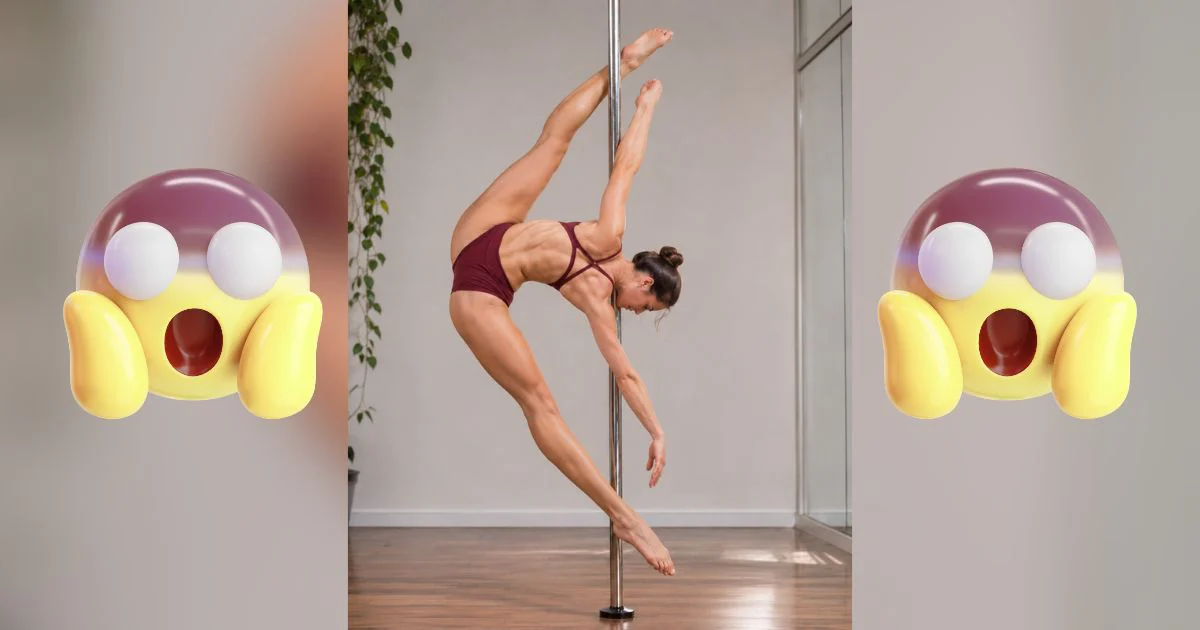
If you’ve scrolled pole Instagram for more than five minutes, you’ve seen one. The dancer is upside down with the pole running along their back, legs dropped open into a deep, wide straddle and chest pushed forward and away. From the front, the whole body opens out flat. The name comes from the cooking term for a chicken that’s been butterflied and pressed flat, which is a fairly accurate (if unglamorous) description of the shape.1
It’s not an easy trick. Pole physio Simone Muscat breaks it down as end-of-range hip flexion, abduction and external rotation (basically a full pancake stretch), plus an anteriorly tilted pelvis, an extended spine and pulled-back shoulder blades, all at once and upside down.1 In other words, it takes serious flexibility and the strength to control it.
The International Pole Sports Federation has its own name for the shape: the crossbow.1 Keep that in mind, because the federation is where this story starts.

Where the spatchcock came from
The trick is credited to Felix Cane, the Australian dancer who dominated pole competition in the late 2000s. According to The Pole Physio, Cane debuted it at Miss Pole Australia in 2008, and it hit peak fame shortly after at the World Pole Dance Championships in Jamaica in 2009. The same account says she named it after feeling gravity pull her body open.1
Cane’s record from that era speaks for itself: Miss Pole Dance Australia in 2006, again in 2008/9 and 2011, and World Pole Dance champion in 2009 and 2010. She also went on to perform with Cirque du Soleil in Zumanity.2 So by 2015, the spatchcock wasn’t some fringe move. It was the signature trick of one of the most decorated pole dancers in the world, and studios everywhere were teaching it.
Who is Katie Coates?
Katie (often “KT”) Coates co-founded the International Pole Sports Federation (IPSF) with Tim Trautman in 2009. The idea was to turn pole into a recognized sport, with standardized rules, a code of points, trained judges and an annual world championship. The IPSF began running its World Pole Championships in 2012 and has said openly that it wants pole in the Olympics. In 2017 it was granted observer status by GAISF, the umbrella body for international sports federations.3
That’s the context that matters here. Coates wasn’t just a dancer with an opinion. She was the president of an organization that writes a scoring code for competitive pole, which is exactly why her next post landed the way it did.
The post: “SPATCHCOCK = UGLY”
In March 2015, Coates posted a status on Facebook. The wording, as quoted by the Australian studio Pole Athletica, went like this:4
“SPATCHCOCK = UGLY. Yes I said it! It’s the most horrific pole move ever created. If it was up to me it would be banned from the code and everyone told to put their giblets away!”
Katie Coates, Facebook, March 2015, as quoted by Pole Athletica
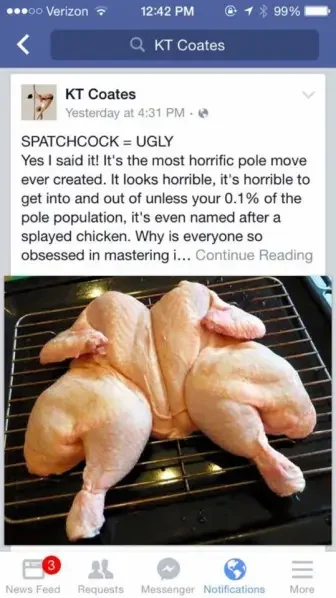
Plenty of people have strong opinions about how a trick looks. Plenty of judges have aesthetic preferences. What made this different was the “banned from the code” line. Coming from the president of the federation that writes a code of points, it was easy to read as more than personal taste.
Add the “giblets” line, and the post was always going to travel.
The thread gets worse
The status itself was only the start. According to Poleitical’s write-up at the time, Coates “doubled down” later in the same comment thread, including what the blogger described as a “poorly veiled dig” at Felix Cane, the woman who created the move.5 The comment itself isn’t quoted in that post, so we’re relying on the blogger’s description.
Cane defended herself in the thread, and others jumped in to defend both her and the trick. Somewhere in there, the idea took hold that the best answer wasn’t another argument. It was a photo.5
The spatchy uprising
What happened next is the part people still remember. Pole dancers started posting their spatchcocks. Pros, instructors, students, anyone who could get into one. Pole Athletica described Cane herself and other pole performers posting comments and pictures of their spatchcocks “in retaliation,” and noted that the post seemed to have had “quite the opposite effect” to the one intended: “the Spatchy is back on trend.”4
Studios joined in, too. Pole Athletica’s own post mentions one of its instructors posting a spatchcock photo, and that its director placed at the Australian Pole Championships in 2013 partly thanks to hers.4 For a while there, posting a spatchcock was a small act of solidarity.
Meanwhile, the blog post that named what was happening went viral in its own right. Two days after “A Little About Pole Bullies” went up, its author wrote that it had taken off after Felix Cane shared it, with more than 800 Facebook shares and over 6,000 views in a single day.6 For a niche pole blog in 2015, that’s a lot.
Bigger than one trick: the “pole bullies” debate
The most interesting thing about the spatchcock row is what it turned into. The Poleitical posts weren’t really about a trick at all. They were about how people in the pole community talk to and about each other, especially people with power.
In the first post, the blogger argued that public figures in pole needed to think harder about their image, suggesting they “hire professionals to help you with your public image, if you can’t keep it together on your own.” She also linked to a post by Alex Shchukin, the Ukrainian pole champion, about his own experience with Coates.5
Shchukin’s post, “Pole dance bully,” went up the same day. It opens with him scrolling through a Facebook feed “full of spatchcocks” and wondering if it’s a flash mob, before finding out why. “How can KT say that spatchcock – Felix’s signature trick is ugly?” he wrote. He said he had won an IPSF championship, described a run of increasingly rude emails, and said he was later suspended from the IPSF after an opening routine at an event in Switzerland, which he felt was unfair. His conclusion: “We have to fight the bully.”7 That’s his side of the story, and we haven’t found a public response to it from Coates or the IPSF.
But she was just as firm with the people piling on. Her line, which still holds up:
“Bullying the bully isn’t the answer.”
Danielle C., Poleitical, March 2015
Personal attacks on Coates, she wrote, were “no better than her behavior.” Her advice was to support the people being targeted and to “call out the bullies in clear, direct, and sensible ways.”5
In the follow-up, she said she’d used Coates as “the most recent example in a widespread problem,” not to single her out, and pointed to bullying at every level of pole: new students left out at studios, owners not paying teachers and guest instructors. She also gave a second example that cut the other way. When dancer Oona Kivelä posted a video criticizing the sexy side of pole and Michelle Shimmy called her out, some of the comments aimed at Kivelä went after her own movement. “Telling Oona she sucks at sexy movement is not any better than Oona trashing it herself,” the blogger wrote.6
That’s a pretty mature take for the middle of an internet pile-on, and it’s why the episode is worth looking back on. The spatchcock was the spark. The real argument was about whether “aesthetic opinion” from people who judge and govern the sport can be separated from how it lands on the dancers it describes.
Did anything come of it?
As far as we can find, nothing official. We couldn’t find a public statement, clarification or apology from Coates or the IPSF about the post, and there’s no record of the spatchcock (or the crossbow) being banned. If one exists, we’re happy to add it here.
What did last was the debate about whether the trick is beautiful. When physio Selina Tannenberg of MoveMedics republished her guide to the spatchcock in 2019, she noted that her original 2015 post had landed “right in the middle of a great debate about the Spatchcock’s aesthetics.”8 And the trick itself never went anywhere. Cane’s own competition, the Felix Cane Pole Championships, has since promoted the spatchcock as “The Ultimate Mid Week Middle Split” on its Facebook page.9
Ugly or not, it won.
Want to try one? Read this first
If all this has you eyeing the pole, a word of caution. The spatchcock asks a lot of your hips and hamstrings, and it asks for it upside down. MoveMedics warns that attempting it without the right movement qualities “puts you at risk of injury,” and says plenty of adductors and hamstrings have been injured that way.8
Physio tip
For extreme flexibility tricks like this, MoveMedics recommends only ever using a maximum of 85% of your available range, and leaving at least 15% spare “to allow for error,” in case you’re tired, sweaty or slip.8 If your pancake stretch isn’t there yet, the spatchcock isn’t either.
Work on your straddle and pancake on the floor first, make sure your inverts are solid and controlled, and learn it with a qualified instructor and a spotter. Your giblets will thank you.
More pole drama deep dives
This is part of our look back at the arguments that shaped the online pole community. Next up: the summer Instagram hid pole dancing, and the #NotAStripper vs. #YesAStripper hashtag fight.
Sources
- Simone Muscat, “Understanding the Spatchcock”, The Pole Physio, August 15, 2020, updated May 20, 2023. Covers the trick’s origin, the name, and the mobility it requires. ↩︎
- “Felix Cane”, Wikipedia. ↩︎
- “International Pole Sports Federation”, Wikipedia. Founding, World Championships, Olympic goal and GAISF observer status, with links to the original press coverage. ↩︎
- “Long Live the Spatchy”, Pole Athletica studio blog, undated. Quotes the Facebook status in full. ↩︎
- Danielle C., “A Little About Pole Bullies”, Poleitical, March 13, 2015. ↩︎
- Danielle C., “A Lot More About Pole Bullies”, Poleitical, March 15, 2015. ↩︎
- Alex Shchukin, “Pole dance bully”, alexshchukin.com, March 13, 2015 (archived copy; the original is no longer online). ↩︎
- Selina Tannenberg, “How to Spatchcock”, MoveMedics, first posted 2015, republished September 5, 2019. ↩︎
- Felix Cane Pole Championships, “The Ultimate Mid Week Middle Split – The Spatchcock”, Facebook video post. ↩︎
Want more articles like this?
Join our mailing list to be the first to know about the latest pole dancing news and products.
We only include the best content in our newsletter, which includes marketing material. Privacy Policy
NO SPAM – EVER. YOU CAN UNSUBSCRIBE AT ANY TIME.
Leave a Reply