
Your arms get you onto the pole, but your core decides whether you go upside down smoothly or with a lot of grunting. These 12 core exercises for pole dancers need nothing more than a mat, a resistance band and something to hang from, so you can train them at home on the days you can’t get to the studio.
Each exercise comes with simple steps, an easier and a harder version, and the pole moves it helps, followed by a 20-minute routine. If you’d rather work on dance and flow at home, see Pole Dancing Without a Pole.
You will learn:
- Which core muscles do the work in inverts, sideways holds and controlled descents
- 12 at-home core exercises, each with easier and harder versions
- A 20-minute pole core workout you can do without a pole
- How often to train your core and how to progress safely
Why core strength matters on the pole
On the pole, your core has to lift your legs over your head, stop your body twisting away from the pole, and hold you straight when gravity wants you to fold in half.
Take a basic invert. Before your legs leave the floor, your abs brace your trunk and your pelvis tucks under (a posterior tilt) so your hips can rise toward the pole. Then your hip flexors drive your knees up while your lats pull your arms to your sides. Without a stable trunk, the lats and hip flexors tend to take over and arch your lower back.1
Sideways holds ask even more. In an Iron X or a flag your body sticks out from the pole like a plank on its side, and closing the legs for a flag puts more load on your shoulders, back and abs.2 Then there’s the part nobody posts on Instagram: coming down slowly instead of dropping onto your feet, which is why some exercises below focus on the lowering.
Your pole core in plain anatomy
“Core” means more than the six-pack. These are the muscles you’ll feel working:
- Rectus abdominis: the long muscle down the front of your belly that keeps your body stable while you move and curls your ribs toward your hips.
- Obliques (internal and external): the muscles at your sides that let your trunk twist and turn.3 On the pole they mostly stop you twisting and hold you up in side-on shapes.
- Transverse abdominis: the deepest layer, wrapping around your middle. It helps stabilize your trunk and keep pressure inside your abdomen,3 which is what “brace your core” is really asking for.
- Hip flexors: mainly the iliopsoas, plus part of the quads. They lift your legs toward your chest in every tuck, pike and straddle.
- Lats (latissimus dorsi): the big back muscles linking your upper arms to your spine and pelvis. Anatomists call them a climbing muscle: with your arms fixed overhead, they help lift your trunk,4 which is pretty much a description of pole.
Safety notes before you start
This is general fitness advice, not medical advice. Stop any exercise that causes sharp or lasting pain and see a doctor or physical therapist rather than training through it. If you have a history of back pain, get it checked before adding lots of new core work.
If you’re pregnant, have recently had a baby, or see a ridge or dome along the middle of your stomach when you sit up, talk to your doctor first. That ridge can be a sign of diastasis recti, a separation of the abdominal muscles. Cleveland Clinic says it affects 6 in 10 women after childbirth, and lists crunches, unmodified planks, double leg lifts and anything that makes your abdomen bulge, cone or dome among the exercises to avoid with it.5 Several moves here fall into those groups, so get checked first. A pelvic floor physical therapist can give you a plan that fits your body.
Warm up first (try our quick warm-up for pole dancers) and train on a mat with clear space around you.
12 core exercises for pole dancers
They run from floor basics to harder strength work. Start with the easier version of each and move up when the full set feels solid.
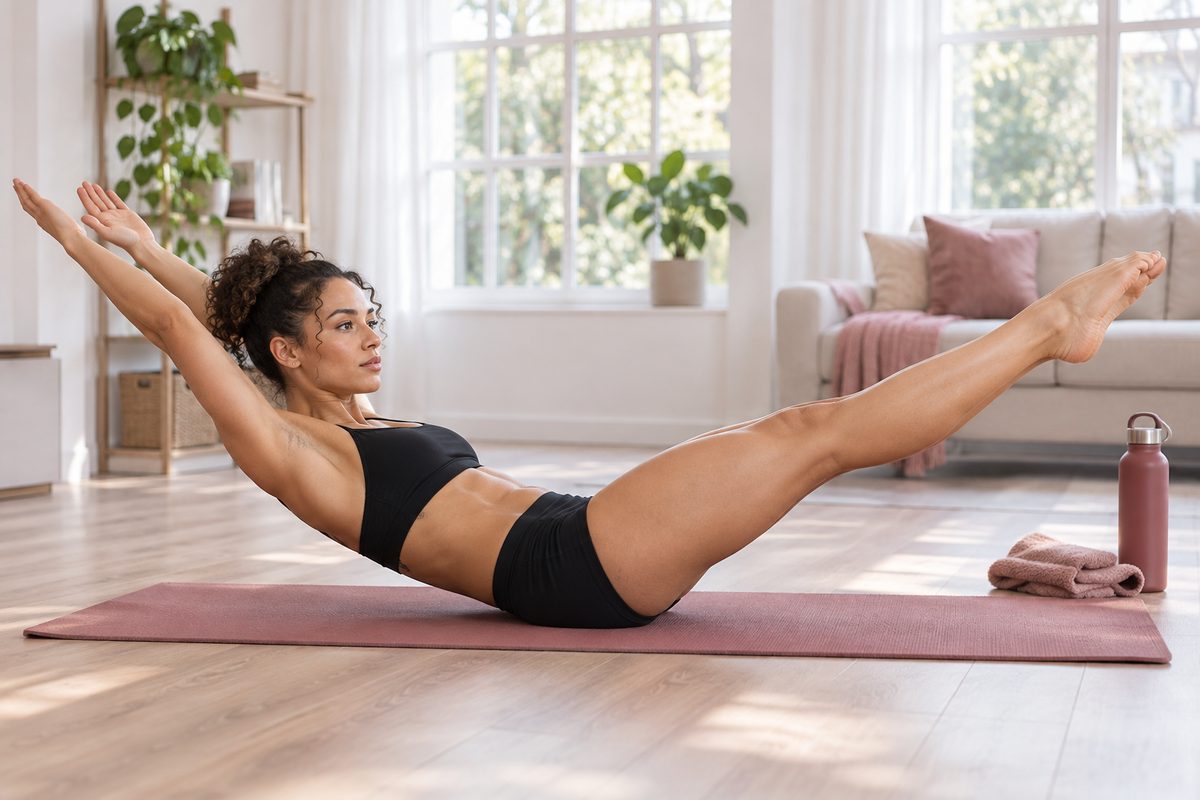
1. Hollow body hold
Helps with: the long, straight body line in inverts, straight-leg shoulder mounts and the superman.
- Lie on your back and press your lower back gently into the floor.
- Reach your arms overhead and lift your shoulders and straight legs a few inches off the mat into a shallow banana shape.
- Hold for 15 to 30 seconds without letting your lower back peel off the floor.
Easier: bend your knees and keep your arms by your sides. Harder: lower your arms and legs closer to the floor, or rock gently in the hollow shape.
2. Dead bug
Helps with: keeping your trunk steady while your legs move, as when you open into an inverted V.
- Lie on your back with your arms pointing at the ceiling and your knees bent at 90° over your hips.
- Slowly lower your right arm overhead and your left leg toward the floor, keeping your lower back down.
- Return to the start and switch sides. Do 6 to 10 per side.
Easier: keep the knee bent and just tap your heel to the floor. Harder: straighten the leg fully and take three or four seconds to lower it.
3. Reverse crunch
Helps with: the pelvic tuck that lifts your hips toward the pole in a basic invert.
- Lie on your back with your hands by your sides and your knees bent over your hips.
- Curl your hips off the floor and draw your knees toward your chest, as if rolling your tailbone up.
- Lower slowly. Aim for 8 to 12 without swinging your legs.
Easier: make the movement smaller. Harder: straighten your legs a little more and pause at the top.
4. Slow leg lowers
Helps with: lowering out of an invert with control instead of thudding onto the mat.

- Lie on your back with your legs straight up toward the ceiling and your hands under your hips or by your sides.
- Take four or five seconds to lower your legs, stopping before your lower back starts to arch.
- Bend your knees to bring them back up, then repeat 6 to 8 times.
Easier: lower one leg at a time. Harder: lower closer to the floor and lift back up with straight legs.
5. Hanging knee raise
Helps with: tucking from a hang, the start of every aerial invert. In an American Council on Exercise study of 13 ab exercises, a similar move done in a “captain’s chair” (supported on your forearms) ranked first for the obliques and second for the rectus abdominis.6
- Hang from a secure pull-up bar and gently pull your shoulders down, away from your ears.
- Without swinging, lift your knees toward your chest and tuck your pelvis at the top.
- Lower slowly. Do 5 to 10.
Easier: practice the active hang, or lift one knee at a time. Harder: knees to elbows, then straight legs. If your grip tires first, try our tips to improve grip strength at home.
6. Tuck-up or V-up
Helps with: the deep fold (compression) of a tuck invert.
- Sit on the mat, lean back slightly and balance on your sit bones with your hands on the floor behind you.
- Extend your legs out long as you lean back, then pull your knees in toward your chest as you sit up.
- Do 8 to 12 smooth reps.
Easier: keep your feet touching the floor. Harder: lift your hands, or progress to a full V-up from flat on your back.
7. Pike compression lift
Helps with: straight-leg straddles and pikes, and eventually deadlifts.
- Sit tall with your legs straight and together, your hands flat on the floor beside your knees.
- Lean slightly forward and lift both heels an inch or two off the floor without leaning back.
- Hold for two seconds, lower and repeat 8 to 10 times.
Easier: lift one leg at a time. Harder: move your hands back toward your hips, or try it in a straddle. A cramp in the front of the hip is common at first.
8. L-sit progression (parallettes or chairs)
Helps with: combining a strong core with pushing shoulders, which you’ll need for deadlifts and handsprings later on.
- Place parallettes, or two sturdy chairs that won’t slide or fold, just wider than your hips.
- Grip with straight arms and push your shoulders down so you grow tall between your hands.
- Lift your feet into a tuck and hold for 5 to 15 seconds.
Easier: keep your heels on the floor and just lift your hips. Harder: straighten one leg, then both, into a full L-sit.
9. Side plank with reach
Helps with: holding your body sideways in flags, the Iron X and the superman. It’s one of the “big three” exercises spine researcher Stuart McGill developed for spine stability.7
- Lie on your side, propped on your forearm, and lift your hips so your body forms a straight line.
- Reach your top arm to the ceiling, then thread it under your body as you rotate slightly toward the floor.
- Reach back up. Do 6 to 8, then switch sides.
Easier: keep your bottom knee on the floor, or skip the reach and simply hold. Harder: balance on a straight arm or lift your top leg.
10. Bird dog
Helps with: balancing all that front-body work with a stable back, which keeps your hips level in leg hangs. It’s another of McGill’s big three.7
- Start on your hands and knees with your hands under your shoulders.
- Reach one arm forward and the opposite leg back until both are level with the floor.
- Hold for up to 10 seconds without letting your hips tip, then switch. Do 5 per side.
Easier: move just the arm or just the leg. Harder: draw your elbow and knee together under your body between holds.
11. Pallof press (band anti-rotation)
Helps with: stopping your body twisting away from the pole in split grip holds and on a spinning pole.
- Anchor a resistance band at chest height (a door anchor works) and stand side-on to it.
- Hold the band at the center of your chest with both hands, then press it straight out in front of you.
- Hold for two seconds without letting the band turn you, then bring it back. Do 8 to 10 per side.
Easier: step closer to the anchor so the band pulls less. Harder: step farther away, or do it from a half-kneeling position.
12. Straight-arm plank to pike
Helps with: lifting your hips over your shoulders, the pattern behind shoulder mounts and handsprings, using your lats and abs together.
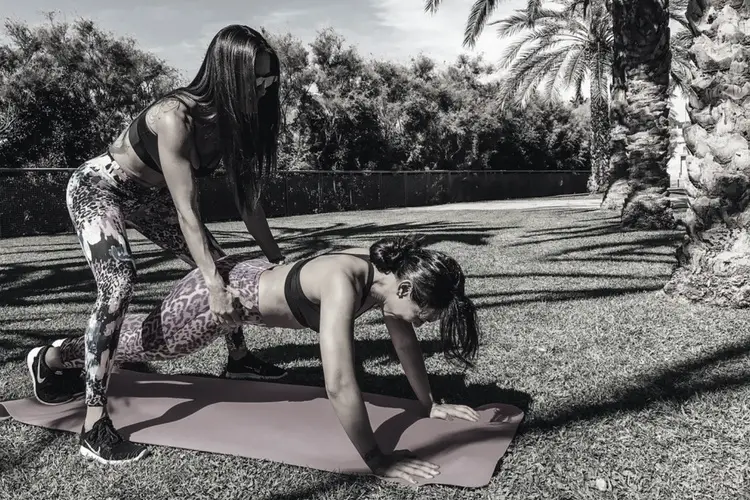
- Start in a straight-arm plank with your hands under your shoulders.
- Push the floor away and lift your hips high into a pike, keeping your legs as straight as you can.
- Lower back to plank with control. Do 6 to 10.
Easier: walk your feet in toward your hands. Harder: slide your feet in on sliders, or in socks on a smooth floor.
Pro tip
Breathe out as you lift or tuck, and don’t hold your breath through a whole set. If your stomach domes up in the middle during an exercise, go back to the easier version.
A 20-minute pole core workout
Use a timer, and pick easier or harder versions to suit the day.
| Time | What to do | How |
|---|---|---|
| 0:00 to 3:00 | Warm-up | Marching, arm circles, cat-cow and a few slow dead bugs |
| 3:00 to 9:00 | Circuit, round 1: hollow body hold, dead bug, reverse crunch, side plank with reach (left), side plank with reach (right), bird dog | 40 seconds work, 20 seconds rest for each (split the hollow hold into shorter holds if you need to) |
| 9:00 to 15:00 | Circuit, round 2 | Same six exercises; try a harder version of one or two |
| 15:00 to 18:00 | Strength block: hanging knee raises (or tuck-ups if you have no bar) | 3 sets of 5 to 8, about 30 seconds rest between sets |
| 18:00 to 20:00 | Pallof press, then cool down | 30 seconds each side, then a minute of gentle stretching |
On another day, swap the circuit for slow leg lowers, pike compression lifts, L-sit tucks and straight-arm plank to pike, so you train both tuck strength and control.
How often should pole dancers train their core?
Two or three sessions a week, on non-consecutive days, is plenty for most people. That fits the US Physical Activity Guidelines, which recommend that adults do muscle-strengthening activity on at least two days each week.8 Pole class works your core hard too, so count it: after a heavy invert class on Tuesday, a big core session on Wednesday won’t do you any favors.
Some soreness a day or two after a new routine is normal. If it lingers, see our tips to recover from muscle soreness or DOMS, and read How Often Should You Practice Pole Dancing? to plan your whole week.
How to progress your pole conditioning at home
Change one thing at a time, once the current version has felt solid for a few sessions:
- Longer levers: straighter legs and arms farther from your center make everything harder.
- Slower lowering: take three to five seconds on the way down.
- Less support: move from the floor to a bar, or from two legs to one.
- More time or reps: add five seconds to holds or two reps to sets.
Inverts and mounts also need strong shoulders and lats, so pair this routine with our guide to upper-body strength for pole dancing and, if a shoulder mount is your goal, our shoulder mount conditioning tips. Strength alone won’t teach you to invert, though. Learn it on the pole with a qualified instructor, a spotter and a crash mat; When Can I Do a Pole Invert? explains what most instructors look for, and our step-by-step invert guide breaks down the move itself.
Your first week of core training
Keep the first week modest: do the 20-minute workout twice with the easier versions, a couple of days apart, and note which exercises felt shaky. Those weak links are usually the ones that make the biggest difference the next time you tuck upside down in class.
Sources
- Simone Muscat, “Anatomy of a Straddle”, The Pole Physio, 2020 (updated 2023). thepolephysio.com ↩︎
- Simone Muscat, “Anatomy of an Iron X & Human Flag”, The Pole Physio, 2021 (updated 2023). thepolephysio.com ↩︎
- Cleveland Clinic, “Abdominal Muscles”, 2024. my.clevelandclinic.org ↩︎
- Molly Smith (reviewed by Jana Vasković, MD), “Latissimus dorsi muscle”, Kenhub, reviewed November 2023. kenhub.com ↩︎
- Cleveland Clinic, “Diastasis Recti”, medically reviewed April 2025. my.clevelandclinic.org ↩︎
- American Council on Exercise, “ACE-sponsored Study Reveals Best and Worst Abdominal Exercises” (study led by Peter Francis, PhD, San Diego State University Biomechanics Lab), May 2001. acefitness.org ↩︎
- Harvard Health Publishing, “Three moves for better spine health”, August 2020. health.harvard.edu ↩︎
- US Department of Health and Human Services, Physical Activity Guidelines for Americans, 2nd edition, 2018 (“Top 10 Things to Know”). odphp.health.gov ↩︎
Want more articles like this?
Join our mailing list to be the first to know about the latest pole dancing news and products.
We only include the best content in our newsletter, which includes marketing material. Privacy Policy
NO SPAM – EVER. YOU CAN UNSUBSCRIBE AT ANY TIME.