
Pole dancing injuries are more common than most beginners expect, but they aren’t random. The research so far points to the same few places again and again (shoulders, wrists, hamstrings and skin), and most of the ways to protect them are things you can start in your next class.
This guide pulls together what the published studies actually found, explains the usual injuries in plain terms, and covers the habits that keep dancers training for years instead of weeks. It’s general fitness information, not medical advice. If something hurts, a doctor or physical therapist is the right person to look at it.
You will learn:
- How often pole dancers get hurt, according to real studies
- Why shoulders, wrists and hamstrings take most of the strain
- The most common injury types, explained without the jargon
- Practical ways to lower your risk, at home and in the studio
- When it’s time to stop and see a doctor or physical therapist
Is pole dancing dangerous? What the research says
Pole is a demanding sport. You hang your whole body weight from your hands, flip upside down and hold positions that would make a gymnast think twice, so some risk comes with the territory. The good news is that researchers have started counting, and the picture is clearer than it was a few years ago.
The most detailed study so far followed 66 pole dancers from 41 studios across Australia for 12 months, with each dancer logging their training in a daily online diary. Across all new injuries, the rate was 8.95 per 1,000 hours of exposure, or very roughly one injury for every 110 hours of training. The shoulder was the most often injured area (20.4% of injuries), followed by the thigh (11.7%, mostly the hamstring). Only 25 of the 66 dancers completed the full year, so treat the exact figure with some caution.1
A global online survey of pole dancers, run over two weeks in March 2019, found the same pattern. Shoulder injuries were the most commonly reported (54.5%), followed by wrist (34.2%) and back (24.7%) injuries, and about three-quarters of injuries happened suddenly rather than building up over time. Dancers aged 40 and over were about 3.7 times more likely than dancers aged 19 to 29 to need more than three months to recover.2
Other surveys back this up. In a Polish survey of 320 female pole dancers, more than 85% said they’d had some kind of injury, and bruises (contusions) made up 60% of the injuries reported.3 A 2024 systematic review pulled five studies together (787 dancers in total) and found injuries split fairly evenly between the upper body and the lower body, but it also concluded that there’s still very little good research on pole injuries.4
So is pole dancing dangerous? It’s a high-skill sport with a real injury rate. Most of what gets reported is bruising, strains and overuse, not catastrophe, and a lot of it is linked to things you can control.
Why the shoulders, wrists, hamstrings and skin take the brunt

Shoulders
In everyday life your shoulders mostly move your arms around. On the pole they hold you up, often with your arm overhead, twisted or behind you. In the Australian study, the most common contributor to shoulder injuries (a third of them) was moves that load the shoulder while the upper arm is rotated inward.1 That’s exactly why grips like twisted grip get so much debate, which we cover in The Truth About Twisted Grip.
Wrists
Your wrists carry you through every grip, every handspring and every floorwork push-up. They’re small joints doing big-joint work, and they rarely get the warm-up or strength training that shoulders do.
Hamstrings
Pole rewards flexibility, and splits shapes show up everywhere, from the floor to the top of the pole. In the Australian study, moves and positions involving front splits were the main contributor to every hamstring injury.1 A separate Polish survey of 213 women found that the biceps femoris (one of the hamstring muscles) was one of the most commonly injured areas, especially among professional dancers.5
Skin
Pole is one of the few sports where your bare skin is part of your grip. Knee pits, inner thighs, ankles and the tops of your feet all press hard against metal, which is why so many dancers walk around with a collection of bruises and the odd friction burn.
Common pole dancing injuries in plain terms
These are the injuries dancers most often talk about. They’re described here so you know the words your doctor or physical therapist might use, not so you can diagnose yourself.
Rotator cuff strain and shoulder impingement
The rotator cuff is a group of four small muscles that keep the ball of your upper arm centered in the shoulder socket. When they’re tired or overloaded, they can get strained or irritated. Impingement is a general term for pain when tissues in the shoulder get pinched as you lift your arm. Dancers often notice either one as an ache at the front or side of the shoulder, especially when reaching overhead.
Wrist strain
Wrist strain usually builds up from repeated loading: lots of grip work, handsprings or weight on bent wrists. It often starts as a niggle that you notice when you push up off the floor. There are more ideas in How To Protect Your Wrists When Pole Dancing.
Hamstring strain
A hamstring strain is a stretched or torn muscle at the back of the thigh. In pole it often happens when someone forces a split that isn’t warm or isn’t ready yet, sometimes with body weight or the pole pushing them deeper. Dancers often describe a sharp pull or a pop high up near the sit bone.
Bruises and skin burns

Bruises are the classic beginner badge. They tend to appear on the inner knees, shins and thighs while your skin is still getting used to the pressure, and most dancers find they fade as technique and skin toughen up. Friction burns happen when skin slides down the pole under load. Our guide to caring for pole dancing bruises and other injuries has aftercare ideas, and How to Protect your Knees covers floorwork days.
Falls
Falls are less common than strains but can be far more serious, especially from upside-down positions. A 2022 case report described a 23-year-old who fell about one meter (just over three feet) while inverted and landed on her head. She needed spinal surgery and, thankfully, made a full neurological recovery.6 It’s a rare outcome, but it’s the reason inverts belong over a crash mat with someone who knows how to spot you.
How to prevent pole dancing injuries
There’s very little research testing injury prevention programs specifically for pole, so the advice below combines what the studies point to with the habits experienced instructors teach.
Warm up for the work you’re about to do

Raise your heart rate, then move the joints you’re about to load: shoulder circles, scapula shrugs, wrist rolls and some easy leg swings. The authors of one small Polish study named a well-performed warm-up and a balanced diet as the most important protections against acute injuries, and they linked attempts at weight loss with a higher risk of getting hurt.7 Training hard on an empty tank isn’t doing your joints any favors. The 320-dancer survey didn’t find a link between how many minutes dancers spent warming up and their injury risk, so quality and relevance matter more than the clock.3 If you need a routine, try A Quick Warm-Up for Pole Dancers.
Condition off the pole
Pole builds strength, but it doesn’t build it evenly. Rows, band pull-aparts, rotator cuff work with a light band, push-ups and grip training help your shoulders and wrists cope with the load. For hamstrings, strength through the full range (think slow Romanian deadlifts) is a good partner to your splits training. Ask an instructor or physical therapist to check your form if you’re new to this.
Progress slowly
The global survey found that dancers with three to six years of pole experience were 3.9 times more likely to report a moderate or severe injury than less experienced dancers.2 The study didn’t explain why. Still, that’s around the stage when many dancers move on to bigger tricks, so it’s a useful reminder that experience doesn’t make you bulletproof. Add one new demand at a time: a new trick, a new side, more reps or a new pole setting, not all four in one week.
Use a crash mat
A crash mat won’t stop a strain, but it can turn a bad fall into a bruised ego. Use one whenever you’re learning inverts, drops or anything new up high. Our roundup of the best pole dancing crash mats compares the options.
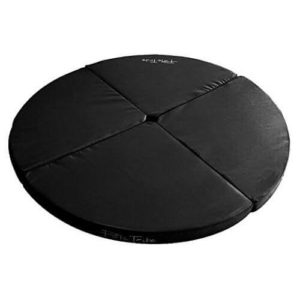
Best for: Learning inverts and new tricks at home
Pole Tribe Crash Mat
At around 3.5 inches thick, it's one of the thicker folding mats we've looked at, so it gives you more cushioning than most if you slip while you're upside down.
- Thicker than most folding crash mats
- 60-inch diameter covers the space around a home pole
- Folds up for storage
- A 5-foot mat needs clear floor space, so small rooms may need rearranging
Manage your grip
Sliding down the pole is how a lot of burns and awkward landings start. Clean the pole before you train, and pick a grip aid that suits your skin: drying products for sweaty hands, tacky ones for dry skin. Too much grip has its own risk, because you can end up stuck in a position your muscles are too tired to hold.
Take rest days seriously
In the 320-dancer survey, dancers who spent more time on pole-specific training had higher odds of injury.3 That doesn’t mean you should train less forever. It means your tendons, skin and joints need recovery time to adapt to the load. Alternate hard pole days with rest, mobility or a different kind of workout.
Don’t train through pain
Some discomfort is normal in pole (skin pinches, muscle burn, next-day soreness), and Does Pole Dancing Hurt? covers what to expect. Sharp pain, joint pain or pain that changes how you move is different. The same survey found that dancers who took a shorter break after an injury, and didn’t fully recover, had higher odds of getting hurt again.3 Coming back too soon is how a two-week problem turns into a two-month one.
Pro tip
Keep a simple training log: what you trained, which side, and anything that felt off. Patterns jump out fast. If your right shoulder complains every time you do three sessions in a row, that’s useful information for you and for your physical therapist.
Learn with a qualified instructor
A good instructor will hold you back from tricks you aren’t ready for, spot you on inverts and catch the small technique faults that load a joint the wrong way. If you train at home, book occasional studio or online lessons to get your technique checked, and learn every invert in person first. Our post on pole dancing studio red flags explains what to watch out for when you choose a studio.
When to see a doctor or physical therapist
You don’t need to book an appointment for every bruise. Do get checked by a doctor or physical therapist if you notice any of these:
- Pain that’s sharp, getting worse or not settling after a few days of rest
- Swelling, a visible change in shape, or bruising that appears without a clear knock
- Weakness, clicking with pain, or a joint that feels unstable or gives way
- Numbness, tingling or pins and needles in your arm, hand or leg
- Pain that wakes you up at night or stops you from doing everyday things
- A felt or heard pop at the time of injury, especially in the hamstring or shoulder
If you hit your head or neck in a fall, or you have numbness, weakness or severe pain afterward, get urgent medical help straight away. A physical therapist who works with dancers or gymnasts is worth seeking out for anything ongoing, because they’ll understand why you need your shoulder to work upside down.
Frequently asked questions
Is pole dancing dangerous?
Pole dancing carries a real injury risk. Most reported injuries are bruises, strains and overuse problems rather than serious trauma. Training with a qualified instructor, using a crash mat and progressing gradually all lower the risk.
What is the most common pole dancing injury?
By count, bruises are the most common. Among more significant injuries, the shoulder comes up as the most often injured area across several studies, followed by the wrist and the hamstring.
Can I keep pole dancing with a shoulder injury?
That’s one for your doctor or physical therapist, because it depends on what the injury is. Many dancers keep training other parts of their practice, like legs-only floorwork or flexibility, while a shoulder recovers, but get the go-ahead first.
Are older pole dancers more likely to get hurt?
The studies we found don’t show that older dancers get hurt more often. The global survey did find that dancers aged 40 and over were more likely to need a long recovery when they were injured. That’s a reason to warm up well and build in rest, not a reason to stay off the pole.
Do wrist supports or knee pads prevent injuries?
There isn’t solid evidence either way for pole dancers yet. Many dancers find knee pads save their skin during floorwork and wrist supports feel reassuring, but neither replaces strength, good technique and sensible progression.
Where to go from here
The research keeps pointing at the same places: shoulders, wrists and hamstrings, with skin taking the everyday knocks. Look after them before they complain. Add a few minutes of shoulder and wrist prep to your next warm-up, put the crash mat down for anything new, and jot down how each session felt. Then come back to the doctor checklist above the next time something twinges and doesn’t let up.
Sources
- Nicholas J, Weir G, Alderson JA, Stubbe JH, van Rijn RM, Dimmock JA, Jackson B, Donnelly CJ. Incidence, mechanisms, and characteristics of injuries in pole dancers: a prospective cohort study. Medical Problems of Performing Artists, 2022;37(3):151-164. PubMed abstract (DOI: 10.21091/mppa.2022.3022) ↩︎
- Lee JY, Lin L, Tan A. Prevalence of pole dance injuries from a global online survey. Journal of Sports Medicine and Physical Fitness, 2020;60(2):270-275. PubMed abstract (DOI: 10.23736/S0022-4707.19.09957-2) ↩︎
- Szopa A, Domagalska-Szopa M, Urbańska A, Grygorowicz M. Factors associated with injury and re-injury occurrence in female pole dancers. Scientific Reports, 2022;12:33. Full text ↩︎
- Scott C, Scott Q, Muscat S. Incidence, prevalence, and characteristics of injuries in pole dancers: a systematic review. Medical Problems of Performing Artists, 2024;39(2):108-118. PubMed abstract (DOI: 10.21091/mppa.2024.2012) ↩︎
- Gołuchowska AM, Humka MI. Types of the locomotor system injuries and frequency of occurrence in women pole dancers. Journal of Sports Medicine and Physical Fitness, 2022;62(5):661-666. PubMed abstract (DOI: 10.23736/S0022-4707.21.12239-X) ↩︎
- Yurac R, Zamorano JJ, Marre A, Diaz C. Traumatic cervical spine injury due to pole dance accident: a potentially catastrophic unreported injury with a happy ending. Case report and literature review. Surgical Neurology International, 2022;13:162. PubMed abstract (DOI: 10.25259/SNI_159_2022) ↩︎
- Naczk M, Kowalewska A, Naczk A. The risk of injuries and physiological benefits of pole dancing. Journal of Sports Medicine and Physical Fitness, 2020;60(6):883-888. A study of 30 trained pole dancers and 30 untrained women. PubMed abstract (DOI: 10.23736/S0022-4707.20.10379-7) ↩︎
Want more articles like this?
Join our mailing list to be the first to know about the latest pole dancing news and products.
We only include the best content in our newsletter, which includes marketing material. Privacy Policy
NO SPAM – EVER. YOU CAN UNSUBSCRIBE AT ANY TIME.