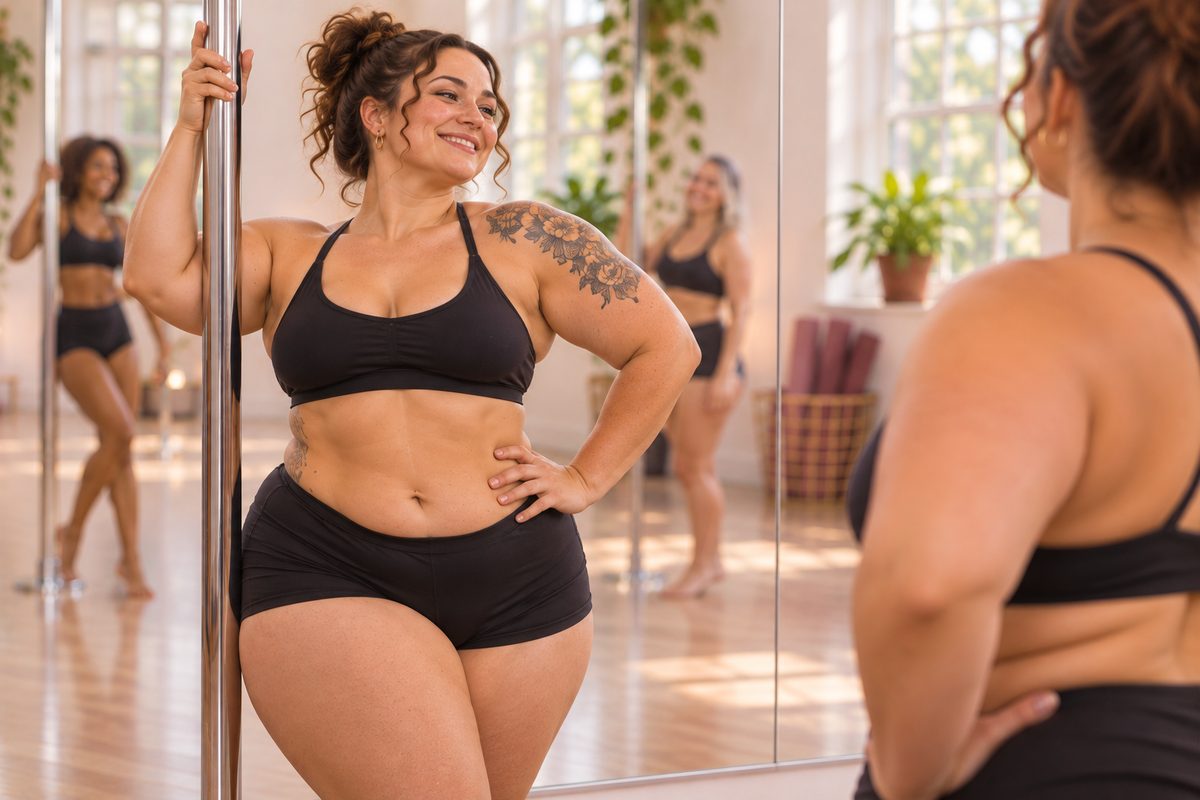

Most people walk into their first pole class worried about one thing, and it isn’t the spins. It’s the shorts. Pole asks you to show a lot of skin, in a room lined with mirrors, next to people you’ve never met. And yet a surprising number of dancers say pole is what finally made them feel at home in their own bodies. Researchers have started to look into why.
This guide covers what the studies actually show (and where they fall short), why pole seems to change the way people see themselves, the things that can knock your confidence, and practical ways to build it from your very first class.
You will learn:
- What “body confidence” really means
- What research on pole dancers has found so far
- Why pole changes the way so many people see their bodies
- The things that can dent your confidence, and how to handle them
- Practical tips for your first few months on the pole
What does body confidence actually mean?
Body confidence gets talked about as if it means loving every inch of yourself every single day. It doesn’t, which is a relief.
Psychologists call it positive body image, and they’re clear that it’s more than not hating your body. In an influential paper on the subject, Tracy Tylka and Nichole Wood-Barcalow describe it as appreciating your body and what it does, accepting the parts that don’t match the ideal, seeing beauty in a wide range of bodies, and filtering out the messages that tear you down.1
That last part matters a lot in pole. You can have a bloated, bruised-shins, bad-hair kind of day and still have a healthy relationship with your body. Confidence isn’t about what the mirror shows you. It’s about how much the mirror gets to decide your mood.
What the research says about pole dancing and body image
For years, the idea that pole builds confidence rested on what instructors and students said about it. Over the last decade, researchers have started measuring it. The studies are small, but they mostly point the same way.
- Pole dancers report a more positive body image. In a 2016 Australian survey, 71 recreational pole dancers scored higher on positive body image and on “embodiment” (feeling at home in your body) than 91 university students.2
- Eight weeks of classes made a measurable difference. In a small 2023 trial in Germany, 50 women were randomly assigned to eight weeks of pole or to a waiting list. The pole group finished with better mental well-being and more appreciation for their bodies.3
- Beginners felt better about their bodies by the end of a course. A 2024 study followed 68 women aged 19 to 60 through eight weeks of twice-weekly beginner classes. Their body appreciation and their sense of their own strength and coordination went up, and nearly 90% of them stuck with it to the end.4
- Dancers describe the same changes in their own words. Interview studies in Canada and South Korea keep turning up similar themes: accepting your body after seeing lots of other bodies, confidence from performing, support from classmates, and pride in new skills.56
I kinda feel like Wonder Woman.
A pole fitness student, quoted in the title of Dimler, McFadden and McHugh’s 2017 study
Now for the honest part. These are small studies, almost all of women, and most of them don’t have a proper comparison group. The authors of the 2023 trial called it a pilot, and general self-esteem didn’t change in that study. A 2026 survey found that pole dancers felt more capable and more in tune with their bodies than non-dancers, but it didn’t report a self-esteem advantage,7 and a Polish study found pole dancers actually felt the pressure to look a certain way more strongly than a comparison group.8
Not everyone buys the “pole is empowering” story, either. Some researchers argue that selling pole as empowerment can quietly repeat old ideas about what makes a woman desirable.9 If you want to read more on both sides of that debate, Samantha Holland’s book Pole Dancing, Empowerment and Embodiment is the classic.10
So pole isn’t a magic fix. But the evidence does suggest it can help, and the way you approach it (and the studio you choose) makes a real difference.
Why pole can change how you see your body
You start judging your body by what it can do
Most workouts are sold on how they’ll change the way you look. Pole doesn’t really work like that. You measure progress in things you couldn’t do last month: your first climb, a held invert, the day your legs finally go over your head without a kick. (If you’re just starting, our list of beginner pole moves gives you plenty to aim for.)
That shift, from how your body looks to what it does, is one of the best-studied routes to a better body image. In a Dutch trial, women who spent a week writing about what their bodies could do felt better about their appearance, appreciated their bodies more, and objectified themselves less than a comparison group.11 Pole teaches the same lesson every time you train, no journal required.
It even seems to hold up under pressure. When researchers interviewed 20 competitive pole dancers in 2025, competition brought plenty of comparison and self-doubt. The women who focused on what their bodies could do, rather than how they looked, were the ones who kept a positive body image on and off the stage.12
You can see yourself getting stronger
Pole is real exercise. When researchers measured experienced dancers through a 60-minute class, it worked out at moderate intensity, around 280 calories, with heart rates averaging 131 beats per minute.13 You won’t be working that hard on day one, but strength comes quickly, and you can see it: in your grip, in your shoulders, in the way you stand. We’ve covered the details in what pole dancing does to your body.

Feeling capable tends to spill over into feeling good about yourself. Across dozens of studies, exercise gives body image a small but real lift,14 and its effect on self-esteem is bigger when people actually get fitter.15 Regular activity helps with mood, too: a large 2023 review of reviews found it eased symptoms of depression and anxiety.16
Skin is part of the technique
New students often assume the tiny shorts are about looking sexy. They’re about friction. Bare skin grips the pole and fabric slides. Once you learn that your inner thighs, the backs of your knees and your waist are working parts, it gets a lot harder to think of them as problem areas. (More on that in what to wear to pole dancing classes.)
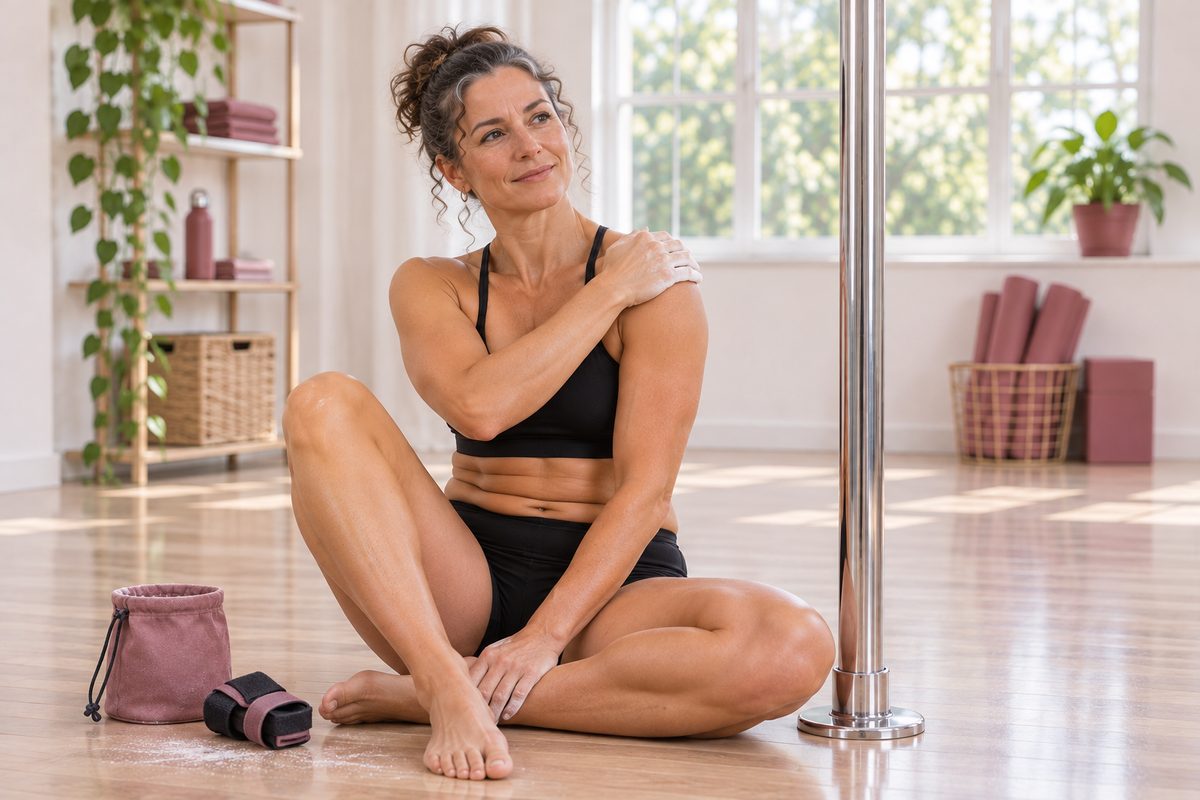
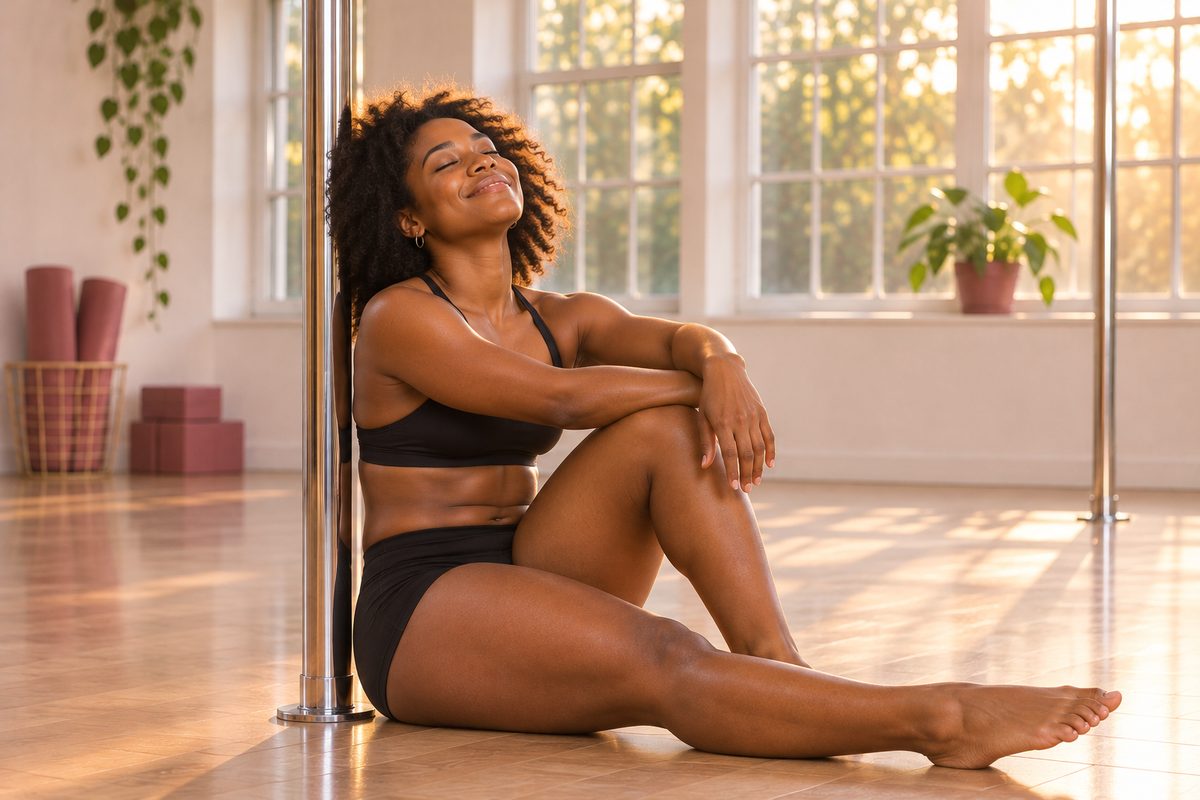
You’re also not the only one in shorts. In class you see real bodies, of every shape and age, doing hard things. In the Canadian interview study, women said that seeing other bodies, and being seen themselves, was a big part of how they came to accept their own.

You get to be sensual on your own terms
Pole has its roots in strip clubs, and many classes still celebrate that history with heels, floorwork and slow, exotic routines. For some people this is the scariest part. For others it’s the whole point.
Psychologists have a name for the habit many women have of watching themselves from the outside: self-objectification. Objectification theory argues that it eats up your attention, feeds shame and anxiety, and makes it harder to get lost in what you’re doing.17 Pole can push you either way. In the 2016 Australian survey, dancers who enjoyed feeling sexy also tended to feel more at home in their bodies, but that same enjoyment was linked to more self-objectification. On the brighter side, the women in the 2023 trial came out of eight weeks of classes with higher sexual self-esteem and less sexual anxiety.
What to take from that: dance sensually because it feels good to you, not because you’re trying to look a certain way for anyone else.
There’s a whole room cheering for you
Ask pole dancers why they keep coming back and plenty will say it’s the people. Clapping when someone lands a new move is standard in most studios, and support from classmates came up again and again in the interview studies above. It’s hard to stay down on your body when a room full of people just cheered your first invert.
What can knock your confidence (and what to do about it)
The mirrors
Nearly every studio has a wall of mirrors, and they’re genuinely useful for checking your lines. But in one experiment, women who were new to exercise felt worse after working out in front of a mirror than women who worked out without one, whatever their usual level of body concern.18 If the mirror is getting in your head, turn side-on, watch your instructor instead, or pick a pole toward the back for the first few weeks.
Social media
Pole Instagram is full of jaw-dropping tricks and incredible bodies. It’s also edited, lit and posted on the best take. In one study, women who looked at “fitspiration” images ended up in a worse mood and less happy with their bodies than women who looked at travel photos, mostly because they compared their own appearance to what they’d seen.19 Follow dancers who share their progress, falls and all, and mute anyone who leaves you feeling behind.
Watching videos of yourself
Filming yourself is one of the best ways to improve, and one of the quickest ways to start picking yourself apart. Watch each clip for one thing only, like pointed toes or straight arms, and ignore everything else. If you’re not ready to watch yet, record anyway and look back in a month. You’ll be amazed at how far you’ve come.
Bruises
You will get bruises, especially at the start, when your skin and technique are still catching up. They fade, and most dancers end up a little proud of them. Here’s how to look after pole bruises and other knocks.
The wrong studio
A good studio adapts moves for different bodies and never comments on anyone’s weight. If an instructor does, or the atmosphere feels cliquey, that’s a problem with the studio, not with you. Our list of pole studio red flags will help you spot the warning signs, and plus-size dancers will find more practical advice in our plus-size pole dancing guide.
How to build body confidence through pole
1. Set goals about skills, not size
“Lose 10 pounds” keeps your attention on how you look. “Hold a fireman spin for a full rotation” or “climb to the top of the pole” keeps it on what you can do, and it’s far more fun to tick off. Keep your goals small and realistic so you get plenty of wins. Need ideas? Try our pole goals.
2. Keep a “can do” list
Write down every new move, every longer hold, every time something that used to scare you didn’t. It’s basically the same exercise that worked in the Dutch body functionality study, and on a bad day it’s proof, in your own handwriting, that your body is doing amazing things.
3. Show skin at your own pace
You don’t have to go straight to hot pants. Plenty of studios are fine with leggings for spins and floorwork in your first few classes. Switch to shorts when you start climbing and need the grip, and add a tank or crop top when you’re ready.
4. Talk to yourself like you’d talk to a classmate
You’d never tell the woman next to you that her thighs look huge in that move. Give yourself the same courtesy. Self-compassion is a skill you can practice: in a 2015 trial, women who listened to short self-compassion meditations for three weeks reported less body shame and dissatisfaction, and more body appreciation, than women on a waiting list (though many participants dropped out along the way).20
5. Practice at home if a class feels like too much
Some people like to build a little confidence privately first. A home pole lets you learn without an audience and turn up to class already knowing a few moves. Read our guide to learning pole dancing at home, compare the best dance poles for home use, and follow our safety tips for home poles before you go upside down.
6. Celebrate the small wins
Every new move and every longer hold deserves a moment. Tell a friend, post it if you want to, or just grin at yourself in that mirror. Noticing your progress is how confidence builds, one class at a time.
Pro tip
Before you leave each class, name one thing your body did well today. It might be a cleaner spin or just turning up when you didn’t feel like it. It sounds cheesy. Do it anyway.
When it’s more than a bad body-image day
Pole can help a lot, but it isn’t therapy. If thoughts about your weight or shape take up much of your day, or you’re cutting back on food or exercising to make up for eating, please talk to your doctor or a mental health professional. The National Institute of Mental Health has clear information on eating disorders and how to find help.
This article is general information, not medical advice.
Pole dancing and body confidence: final thoughts
The research on pole and body image is still young, but it fits with what dancers have been saying for years. When you spend an hour a week focused on what your body can do, surrounded by people of all shapes who are cheering you on, the way you see yourself starts to shift.
The goal isn’t to love the mirror. It’s to care a lot less about it.
Further reading
- 10 Ways to Improve Your Body Confidence
- 12 Amazing Health Benefits of Pole Dancing
- Do’s and Don’ts for Your First Pole Dancing Class
- Pole Dancing for Beginners: What You Need to Know
Sources
- Tylka, T. L., & Wood-Barcalow, N. L. (2015). What is and what is not positive body image? Conceptual foundations and construct definition. Body Image, 14, 118–129. doi.org/10.1016/j.bodyim.2015.04.001 ↩︎
- Pellizzer, M., Tiggemann, M., & Clark, L. (2016). Enjoyment of sexualisation and positive body image in recreational pole dancers and university students. Sex Roles, 74, 35–45. Survey of 162 women aged 17 to 30. doi.org/10.1007/s11199-015-0562-1 ↩︎
- Pfeiffer, J. L., Sowitzki, S. K., Schäfer, T., & Euteneuer, F. (2023). Effects of pole dance on mental wellbeing and the sexual self-concept: A pilot randomized-controlled trial. BMC Psychology, 11, 274. Open access. doi.org/10.1186/s40359-023-01322-z ↩︎
- Nicholas, J., Dimmock, J. A., Alderson, J. A., Donnelly, C. J., & Jackson, B. (2024). Exploring the psychological and physiological outcomes of recreational pole dancing: A non-randomised pilot study. Circus: Arts, Life, and Sciences, 2(2). doi.org/10.3998/circus.2801 ↩︎
- Dimler, A. J., McFadden, K., & McHugh, T.-L. F. (2017). “I kinda feel like Wonder Woman”: An interpretative phenomenological analysis of pole fitness and positive body image. Journal of Sport and Exercise Psychology, 39(5), 339–351. Interviews and observation with seven women aged 20 to 36. doi.org/10.1123/jsep.2017-0028 ↩︎
- Kim, J., Im, S., Lee, R. S., & Heo, J. (2023). Body positivity through creative immersion: A qualitative study of women’s pole dancing experiences. Health Care for Women International, 44(6), 764–781. doi.org/10.1080/07399332.2022.2132252 ↩︎
- Rogowska, A. M., Mikłuszka, M., & Błońska, K. (2026). Relationships between self-esteem, self-efficacy, and interoceptive awareness among pole dancers: A network analysis. Frontiers in Psychology, 16, 1716671. Survey of 263 women, 153 of them pole dancers. Pole dancers scored higher on self-efficacy and body awareness. doi.org/10.3389/fpsyg.2025.1716671 ↩︎
- Staśkiewicz-Bartecka, W., et al. (2026). Body image evaluation and sociocultural attitudes toward one’s own body among women practicing pole dance. Nutrients, 18(5), 814. Survey of 207 pole dancers and 180 women who don’t pole. doi.org/10.3390/nu18050814 ↩︎
- Whitehead, K., & Kurz, T. (2009). “Empowerment” and the pole: A discursive investigation of the reinvention of pole dancing as a recreational activity. Feminism & Psychology, 19(2), 224–244. doi.org/10.1177/0959353509102218 ↩︎
- Holland, S. (2010). Pole Dancing, Empowerment and Embodiment. Palgrave Macmillan. doi.org/10.1057/9780230290433 ↩︎
- Alleva, J. M., Martijn, C., Van Breukelen, G. J. P., Jansen, A., & Karos, K. (2015). Expand Your Horizon: A programme that improves body image and reduces self-objectification by training women to focus on body functionality. Body Image, 15, 81–89. Randomized trial with 81 women. doi.org/10.1016/j.bodyim.2015.07.001 ↩︎
- Ahadi, N. D., Harris, E. A., & Walton, C. C. (2025). A qualitative study of body image among competitive women pole dancers. Psychology of Sport and Exercise, 80, 102920. doi.org/10.1016/j.psychsport.2025.102920 ↩︎
- Nicholas, J. C., McDonald, K. A., Peeling, P., Jackson, B., Dimmock, J. A., Alderson, J. A., & Donnelly, C. J. (2019). Pole dancing for fitness: The physiological and metabolic demand of a 60-minute class. Journal of Strength and Conditioning Research, 33(10), 2704–2710. Measured in 14 advanced amateur dancers. doi.org/10.1519/JSC.0000000000002889 ↩︎
- Campbell, A., & Hausenblas, H. A. (2009). Effects of exercise interventions on body image: A meta-analysis. Journal of Health Psychology, 14(6), 780–793. Meta-analysis of 57 interventions. doi.org/10.1177/1359105309338977 ↩︎
- Spence, J. C., McGannon, K. R., & Poon, P. (2005). The effect of exercise on global self-esteem: A quantitative review. Journal of Sport and Exercise Psychology, 27(3), 311–334. Meta-analysis of 113 studies. doi.org/10.1123/jsep.27.3.311 ↩︎
- Singh, B., et al. (2023). Effectiveness of physical activity interventions for improving depression, anxiety and distress: An overview of systematic reviews. British Journal of Sports Medicine, 57, 1203–1209. Open access. doi.org/10.1136/bjsports-2022-106195 ↩︎
- Fredrickson, B. L., & Roberts, T.-A. (1997). Objectification theory: Toward understanding women’s lived experiences and mental health risks. Psychology of Women Quarterly, 21(2), 173–206. doi.org/10.1111/j.1471-6402.1997.tb00108.x ↩︎
- Martin Ginis, K. A., Jung, M. E., & Gauvin, L. (2003). To see or not to see: Effects of exercising in mirrored environments on sedentary women’s feeling states and self-efficacy. Health Psychology, 22(4), 354–361. Experiment with 58 women. doi.org/10.1037/0278-6133.22.4.354 ↩︎
- Tiggemann, M., & Zaccardo, M. (2015). “Exercise to be fit, not skinny”: The effect of fitspiration imagery on women’s body image. Body Image, 15, 61–67. Experiment with 130 women. doi.org/10.1016/j.bodyim.2015.06.003 ↩︎
- Albertson, E. R., Neff, K. D., & Dill-Shackleford, K. E. (2015). Self-compassion and body dissatisfaction in women: A randomized controlled trial of a brief meditation intervention. Mindfulness, 6, 444–454. 228 women analyzed. doi.org/10.1007/s12671-014-0277-3 ↩︎
Want more articles like this?
Join our mailing list to be the first to know about the latest pole dancing news and products.
We only include the best content in our newsletter, which includes marketing material. Privacy Policy
NO SPAM – EVER. YOU CAN UNSUBSCRIBE AT ANY TIME.


Leave a Reply