
Is pole dancing an Olympic sport? Not yet. As of late 2026, pole sports are not part of the Olympic program, they’re not among the sports confirmed for Los Angeles 2028, and they haven’t featured in any of the Brisbane 2032 shortlist discussions we could find. But that’s far from the whole story.
Competitive pole has world championships, a code of points, para categories and an anti-doping program. It also had a real, documented push for Olympic recognition that got further than most people realize before it stalled. Here’s where things actually stand, what would need to happen for pole to reach the Games, and why not everyone in the pole world wants it to.
You will learn:
- Whether pole is on the program for LA 2028 or Brisbane 2032
- How any sport gets into the Olympics, in plain English
- The history of pole’s Olympic bid, from 2009 to today
- Who governs competitive pole, and why there are two rival federations
- How pole competitions are judged, and the debate over whether pole should be an Olympic sport at all
Is pole dancing an Olympic sport? The short answer
No. Pole has never been part of the Olympic Games, and as of late 2026 it isn’t scheduled to be.
LA 2028: The Los Angeles program has 31 core sports plus five extra sports proposed by the LA organizers and approved by the International Olympic Committee (IOC) in 2023: baseball/softball, cricket, flag football, lacrosse and squash.1 Pole isn’t among them. Even breaking, which made its debut in Paris in 2024, won’t be on the LA program.2
Brisbane 2032: The program isn’t final yet. In November 2026, the IOC set out a revised timetable: an interim classification of disciplines in December 2026, then final confirmation of the program at the IOC Session in April 2027. The Brisbane organizers can propose up to four extra disciplines suited to venues in Queensland. Pole wasn’t mentioned in the coverage of that decision.3 The IOC has also said Brisbane will have fewer sports than LA’s 36, so competition for places is fierce.4
How does a sport get into the Olympics?
In simple terms, there are two big hurdles.
- The IOC has to recognize the sport’s international federation. Recognition is the necessary first step for any sport hoping to reach the Games.5 A federation usually gets provisional recognition first and full recognition later. To qualify, a summer sport’s federation needs at least 50 affiliated national federations, rules that are in line with the Olympic Charter and compliance with the World Anti-Doping Code, among other criteria.6
- The sport has to be put on a specific Games program. Recognition doesn’t guarantee a spot. The IOC decides which sports are on the program, and recent reforms let host cities propose extra sports for their own Games only. That’s how flag football and squash got into LA 2028, and the added sports aren’t guaranteed a place after 2028.7
Pole hasn’t cleared the first hurdle. No pole federation is recognized by the IOC, so pole isn’t yet in a position to be considered for any Games.
A short history of pole’s Olympic bid
The modern push started with the International Pole Sports Federation (IPSF), which was founded in 2009 by Katie Coates and Tim Trautman. The IPSF held its first World Pole Sports Championships in 2012, was approved as a signatory to the World Anti-Doping Agency (WADA) Code in 2016 and applied to the IOC for membership the same year.8
The biggest milestone came in October 2017, when the Global Association of International Sports Federations (GAISF) granted observer status to seven federations, including the IPSF. The others were armwrestling, dodgeball, footgolf, kettlebell lifting, match poker and table soccer. Observer status let these federations attend GAISF’s General Assembly and its annual forum, but not vote.9 It was a first rung on the ladder, not Olympic recognition, but it made headlines around the world. The IPSF announced in November 2019 that its observer status had been renewed for two more years.10

The momentum slowed after that. The 2020 World Championships, planned for Lausanne in Switzerland (home of the IOC), were postponed because of COVID-19.11 In July 2020, Coates told the Alliance of Independent Recognised Members of Sport (AIMS), an IOC-recognized umbrella group for international federations that the IOC doesn’t yet recognize itself,12 that full recognition was “still some way off” for the IPSF.13
Then the ladder itself disappeared. GAISF’s members voted in November 2022 to dissolve the organization, and its final liquidation was approved in September 2023.14 As Slate reported in July 2024, that meant observer sports such as pole lost the status they had, and would need to look to AIMS membership instead. The same article reported that Coates stepped down as IPSF president in March 2024, with Bianca Scholten taking over as acting president.15
Where pole sports stand as of late 2026
The IPSF is still active. It now presents itself as the International Pole and Aerial Sports Federation, runs the World Pole & Aerial Championships and says it is working toward “securing Olympic recognition” for pole and aerial disciplines.16 WADA still lists the IPSF as a Code signatory, in its group of international federations outside the Olympic and Paralympic Movement.17 When we checked in November 2026, the IPSF didn’t appear on AIMS’s published lists of full or associate members.18
Not everyone agrees on how close pole is. In August 2026, the rival Pole Sports & Arts World Federation (POSA) and the APS World League sent the IPSF a public letter asking it to stop describing pole as being on an Olympic pathway. The letter says recognition is decided only by the IOC, that its authors know of no IOC recognition of the IPSF and that GAISF no longer exists.19
So the honest summary is this: as of late 2026, pole sports are not part of the Olympic program, no pole federation holds IOC recognition, and the observer status that once gave the Olympic bid its momentum ended when GAISF closed.
IPSF vs POSA: two federations, one sport
Part of pole’s problem is that it doesn’t speak with one voice. POSA started life as the International Pole Sports and Art Federation (IPSAF) and rebranded in June 2017.20 It runs its own world championships in pole sport, pole art, aerial art and aerial sport, with its own scoring system and judge training.21
A 2019 report in Sports Destination Management laid out the split. At the time, the IPSF had 37 member federations and POSA had 24 endorsed national federations. The IPSF stressed its strict, shared rules and its WADA signatory status, while POSA worked with the World Heavy Events Association on anti-doping and said it would never claim to be “a step away from the Olympics.”22 Two rival world bodies don’t make the case for recognition any easier.
How competitive pole is judged
If you’ve only ever seen pole in a studio or on Instagram, competition pole can be a surprise. IPSF events are split into separate disciplines, each with its own rules.
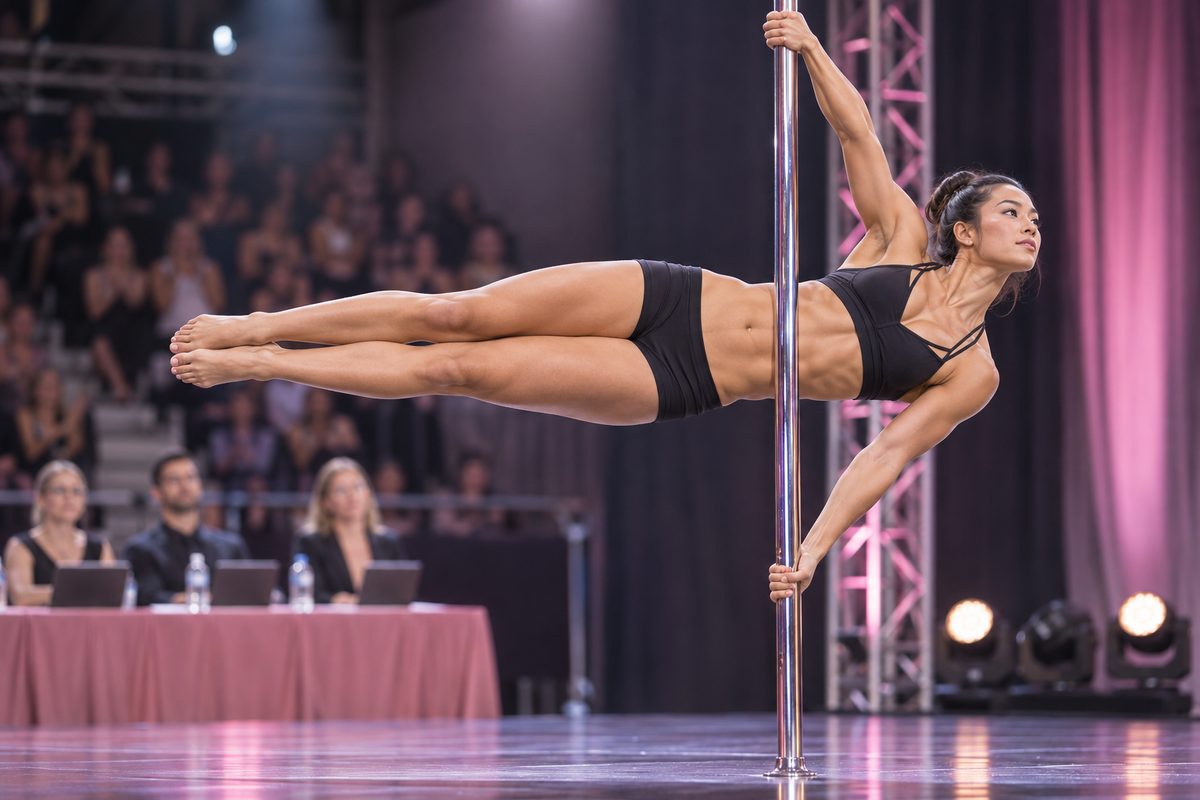
- Pole Sports is the most athletic format. It’s judged against a code of points and focuses more on athleticism and technical merit than artistry, with divisions for competitors aged from 10 to 75.23
- Artistic Pole puts more weight on creativity, choreography and musical interpretation. It’s judged under the IPSF’s Freestyle Pole Series rules, which don’t use a code of points.24
- Ultra Pole is a trick battle. Athletes go head to head in rounds, and the crowd gets a say in the judging.25
- Para Pole was introduced at the 2018 World Championships, with categories for athletes with impaired muscle power, limb deficiency and vision impairment.26
- Aerial disciplines now include aerial hoop and aerial pole (each with sport and artistic formats) and artistic aerial silks.16 If aerial is new to you, here are some unique aerial sports to try.

That structure (codified skills, separate athletic and artistic formats, age groups and para categories) is exactly what an Olympic hopeful needs. It’s also why many dancers already think of pole as a sport. If you’re curious about that side of the argument, read our take on whether pole dancing is a sport or an artform.
Should pole be in the Olympics? The stigma debate
Pole’s Olympic dream has always been tangled up with where pole comes from. Slate’s 2024 piece traced how pole’s roots in the sex industry have fed stigma: gyms turning dancers away, a competition venue canceled in 2012 and instructors’ content being censored online. It also captured a split inside the community. Some dancers and sex workers argue that turning pole into a sanitized sport would erase the strippers who built the art form. Others believe the sport and its stripper roots can happily coexist.15
There’s no single right answer, and you don’t have to pick a side to love pole. A dancer training for a code-of-points routine and a dancer working on a heels flow in eight-inch platforms are both doing something hard, skilled and worth respecting. We’ve written more about this in a woman’s right to pole dance and whether pole fitness and stripping are all that different.
Pole doesn’t need a gold medal to be a sport, an art or both.
What would need to change for pole to reach the Games?
Based on how the IOC process works, here are the signs that would mean pole is genuinely moving closer:
- A pole federation becoming a full or associate member of AIMS
- A pole federation reaching 50 or more affiliated national federations
- Provisional IOC recognition, announced by the IOC itself on olympics.com
- The pole community uniting behind one world governing body
- A host city choosing to propose pole as one of its extra sports
Pro tip
Every few years, a “pole dancing could be in the Olympics” headline goes viral. Before you share one, check the date and look for an announcement from the IOC itself. Federation press releases and old 2017 stories don’t count.
Frequently asked questions
Has pole dancing ever been in the Olympics?
No. Pole has never been on the Olympic program. Its roots go back a long way, though, from Indian mallakhamb to circus and club performance, as we cover in the history of pole dancing.
Will pole dancing be in the 2028 Olympics?
Pole isn’t on the LA 2028 program, and that program is now set.
Could pole be in the 2032 Olympics in Brisbane?
It’s very unlikely. The Brisbane program is due to be confirmed in April 2027, and with no IOC-recognized pole federation, pole isn’t in a position to be considered.
Is pole dancing recognized as a sport?
It depends who you ask. Pole had GAISF observer status from 2017 until GAISF closed, and the IPSF is still a WADA Code signatory, but the IOC doesn’t recognize any pole federation. Plenty of competitions, gyms and athletes treat it as a sport regardless.
How can I compete in pole?
Start local. Many countries have national championships run by IPSF or POSA member federations, plus independent competitions with categories for beginners. Our list of pole dance competitions and how to enter is a good place to begin.
Where pole goes from here
Pole isn’t heading to the Olympics any time soon, and any headline that says otherwise deserves a second look. That doesn’t make competitive pole any less impressive. World championships, para categories and a code of points all exist right now, and you can watch them, judge them or enter them. For more pole trivia you can bring to your next class, see our 17 incredible facts about pole dancing.
Sources
- International Olympic Committee, “LA28 event programme marks strong commitment towards innovation and gender equality”, June 2025, olympics.com ↩︎
- NBC Sports, “Breaking submits bid for Olympic return, hopes for 2032 Brisbane Games”, August 21, 2026, nbcsports.com ↩︎
- Ministry of Sport, “International Olympic Committee approves revised timetable for Brisbane 2032 Olympic sports programme”, November 3, 2026, ministryofsport.com ↩︎
- Associated Press via KSL, “IOC President Kirsty Coventry says sports cut from 2032 Brisbane Games could return in future”, May 27, 2026, ksl.com ↩︎
- Olympedia, “International Federations (IFs)” definition, olympedia.org ↩︎
- Around the Rings, “IOC Executive Board proposes full recognition of six International Federations”, July 2021 (recognition criteria), infobae.com/aroundtherings ↩︎
- NBC Sports, “Flag football, baseball, softball, cricket, lacrosse, squash added to 2028 Olympics”, October 16, 2023, nbcsports.com ↩︎
- International Pole Sports Federation, “History of Pole Sports”, polesports.org ↩︎
- GAISF, “Seven International Federations awarded GAISF Observer Status”, October 2, 2017 (republished by IFMA), muaythai.sport ↩︎
- International Pole Sports Federation, “GAISF Update”, November 4, 2019, polesports.org ↩︎
- International Pole Sports Federation, news, February and March 2020 (Worlds 2020 launch in Lausanne and postponement), polesports.org ↩︎
- Olympedia, “Alliance of Independent Recognized Members of Sport”, olympedia.org ↩︎
- AIMS, “AIMS Will Continue To Support IPSF: The Rise and Development of Pole Sports Worldwide”, July 22, 2020, aims.sport ↩︎
- SportAccord, “Extraordinary General Assembly approves the final liquidation of GAISF”, September 14, 2023, sportaccord.sport; see also Sportcal, “Final liquidation of GAISF approved by members”, 2023. ↩︎
- Brit Dawson, “Opposite Poles” (“Why won’t the Games let pole dancing become a sport?”), Slate, July 27, 2024, slate.com ↩︎
- International Pole and Aerial Sports Federation, home page, ipsfsports.org ↩︎
- World Anti-Doping Agency, Code Signatories (“IFs outside the Paralympic / Olympic Movement”), wada-ama.org ↩︎
- AIMS, Full Members and Associate Members pages, full members and associate members. ↩︎
- APS World League and Pole Sports & Arts World Federation, “Formal Request to Cease and Correct Misleading Communications Regarding Olympic Status”, August 2026, posaworld.org ↩︎
- POSA, “POSA is now IPSAF” (announcement of the IPSAF rebrand to POSA), June 14, 2017, posaworld.org ↩︎
- Pole Sports & Arts World Federation, home page, posaworld.org ↩︎
- Mary Helen Sprecher, “Two Pole Dance Groups Wrestling Over Control: Can the Sport Progress?”, Sports Destination Management, April 17, 2019, sportsdestinations.com ↩︎
- International Pole Sports Federation, “Pole Sport” discipline page, polesports.org ↩︎
- International Pole Sports Federation, “Artistic Pole” discipline page, polesports.org ↩︎
- International Pole Sports Federation, “Ultra Pole” discipline page, polesports.org ↩︎
- International Pole Sports Federation, “Para Pole” discipline page, polesports.org ↩︎
Want more articles like this?
Join our mailing list to be the first to know about the latest pole dancing news and products.
We only include the best content in our newsletter, which includes marketing material. Privacy Policy
NO SPAM – EVER. YOU CAN UNSUBSCRIBE AT ANY TIME.