
From the floor, aerial silks look impossible. Someone climbs a ribbon of fabric to the ceiling, wraps it around one leg and unrolls into a spin. The reality of aerial silks for beginners is a lot less dramatic, and that’s a good thing. You’ll spend most of your first class within a few feet of the mat, learning how to hold the fabric, how to stand on it and how to get off the ground without your arms giving up halfway.
This guide walks through what actually happens in a beginner silks class, what to wear (and what to leave at home), the strength you need and how sore you’ll be afterward. There’s a proper section on safety too, because silks are only ever as safe as the point they hang from.
You will learn:
- What aerial silks are and what they’re made of
- What happens in a first aerial silks class, step by step
- What to wear, and why lotion is a bad idea on class day
- How to build the strength for climbing
- How sore you’ll be, and where fabric burns and bruises turn up
- Why silks must be rigged by a qualified rigger, never DIY
- How silks and pole dancing help each other
What are aerial silks?
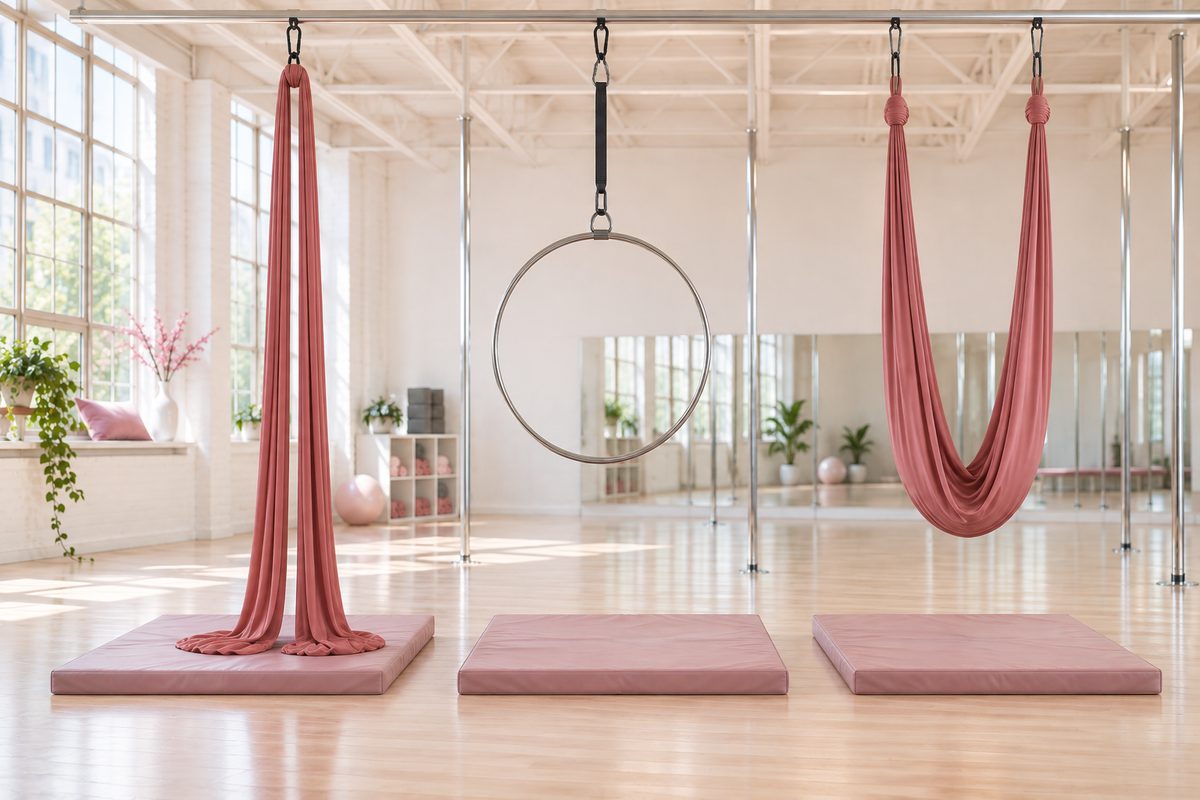
Aerial silks are two long lengths of fabric hanging from a single point overhead. You’ll also hear them called aerial fabric, tissu (French for fabric) or aerial ribbons. Despite the name, they aren’t silk. Most are nylon or spandex, the fabric is doubled so you have two “tails” to work with, and it comes in different amounts of stretch, with low-stretch fabric often suggested for beginners.1
The fabric feels softer than you’d expect and grippier than a pole. It also moves: silks swing, twist and give a little under your weight, so a surprising amount of early training is simply learning to hold still. Our roundup of unique aerial sports to try shows how silks compare with other circus apparatus.

Aerial silks for beginners: what happens in your first class
Most beginner classes follow a similar shape. The fabric is usually hung low or tied in a knot near the floor, and you’ll work close enough to the mat that slipping means stepping down rather than falling. Here’s roughly what to expect.
A warm-up that actually matters
Class starts on the ground with mobility and conditioning, often finishing with a hanging or pulling drill. Don’t skip it if you arrive late. Your hands and shoulders do almost all the work in a silks class, and cold shoulders are unhappy shoulders.
Basic grips and hangs
You’ll learn to hold both tails together with your hands stacked one above the other, then hang with your shoulders engaged instead of dangling from your joints. Instructors often call this an active hang: you draw your shoulder blades down and away from your ears. It’s a tiny movement, but almost every climb and invert is built on top of it.
The foot lock
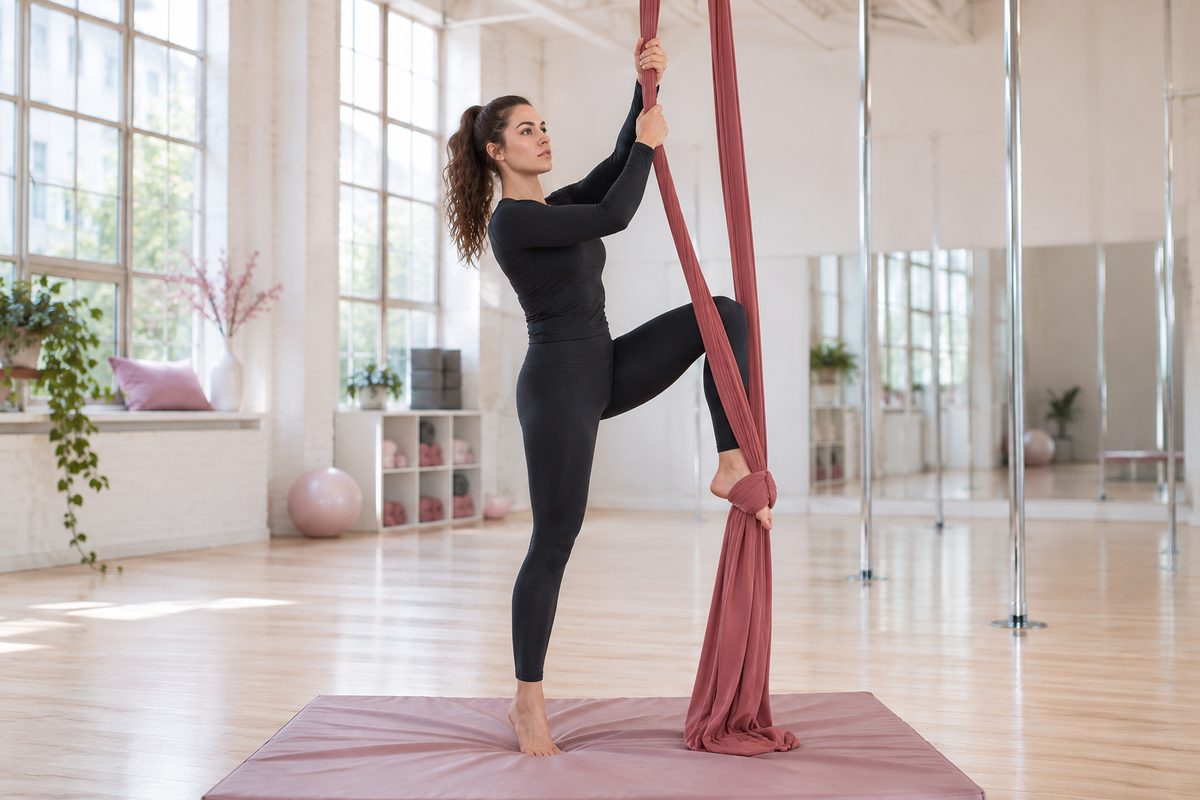
The foot lock is the first real silks skill most people learn. You wrap the fabric around one foot so you can stand on it and take the weight off your arms. Getting the wrap right is fiddly at first, and your foot will feel squeezed. Once it clicks, though, you’re standing in the air with one hand free, and that’s usually the moment people get hooked.
A basic climb
Beginner climbs use your feet to clamp or wrap the fabric so your legs share the lifting. Studios name them differently (you might hear “Russian climb” or “French climb”), but you’ll practice the footwork on the ground first, then try a move or two up. Nobody expects you to touch the ceiling in week one.
Inverts come later
Going upside down is the part everyone looks forward to. Instructors usually teach inverts from the ground or very low on the fabric first, and only add height once you can tuck and lower with control. If your first class doesn’t include one, that’s good teaching, not a slow class.
What to wear to aerial silks class
Silks clothing has one job: keep the fabric off skin where it rubs and away from anything it could snag on. Leave your favorite pole shorts at home.
- Full-length leggings that cover the backs of your knees. Lots of wraps sit right there, and bare skin burns.
- A fitted top that covers your armpits. A baggy shirt flops over your face when you’re upside down.
- Nothing with zippers, buckles or sequins. Metal and hard trims can catch and damage the fabric.
- No jewelry. Rings, earrings, watches and bracelets can snag the silks (and you). Take them off before class.
- Bare feet. Socks make the fabric slippery, and most silks classes are barefoot.
- Hair tied back low. A high bun gets in the way once you’re inverted.
Pro tip
Skip body lotion and hand cream on class day. Moisturizer makes your hands and skin slide on the fabric, which is the last thing you want while you’re learning to hold on. If your skin gets dry, moisturize the night before instead.
How strong do you need to be for aerial silks?
You don’t need to be able to do a pull-up before your first class. Beginner classes are built for people who can’t, and the foot lock exists so your legs can take some of the load. Still, silks lean hard on your grip, shoulders, back and core, and that’s where most beginners feel it first.
Shoulders deserve particular respect. In a 2023 study of preprofessional and professional circus artists in the US, the shoulder was the most commonly injured body region (22% of injuries), and injury rates were higher in aerial disciplines than in ground acrobatics.2 You’re probably not training like a circus pro, but it’s a good reason to build strength gradually and learn that active hang properly.
These exercises help, and you can do most of them with a pull-up bar and a floor:
- Dead hangs. Start with whatever you can hold with good form and add a few seconds each week.
- Scapular pulls. Hang, then pull your shoulder blades down without bending your elbows. This is the active hang you’ll use on silks.
- Hollow body holds. Core tension on the floor now means cleaner tucks and inverts later.
- Negative pull-ups. Jump or step to the top of the bar and lower yourself as slowly as you can.
- Hanging knee tucks. Add these once your dead hang feels solid.
- Grip work. Our guide on how to improve grip strength at home has ideas you can do in front of the TV.
The drills in how to get upper-body strength for pole dancing carry straight over to the fabric. Two or three short sessions a week beat one heroic session followed by five days of regret.
How sore will you be after aerial silks?
Honestly? Pretty sore, the first time. Forearms, the tops of your shoulders, your lats and your abs tend to complain the most. Delayed onset muscle soreness (DOMS) usually shows up 24 to 48 hours after a workout and eases after about 72 hours, and once your body has adapted to a level of effort, repeating it shouldn’t make you as sore again.3 In other words, your second class will usually feel kinder than your first. Our post on ways to recover from muscle soreness has ideas for the days in between.
Fabric burns
Fabric burns are friction burns from skin sliding against the silks. They show up on the backs of the knees, the inner thighs, the tops of the feet and the insides of the arms, especially when you slide down instead of climbing down hand over hand. Covering up helps, and so does learning to control your descent.
Bruises
Silks bruises turn up in odd places: the top of your foot from foot locks, your hips and waist from wraps, the soft skin of your inner arms. A tight wrap can leave quite a souvenir, but the marks fade as your skin and muscles get used to the pressure.
Normal soreness feels dull and achy and improves with gentle movement. Sharp pain, pain in a joint, numbness or tingling, or anything that’s getting worse instead of better means it’s time to stop training and see a doctor or physical therapist.
Aerial silks safety: rigging, mats and good teaching
Silks look soft and forgiving, but you’re hanging your whole body weight from one point, often several feet up, with no safety line. Good rigging, a mat and a trained instructor are what make that safe.
Professional rigging to a rated point
Every silks setup needs a rigging point that’s been assessed and installed by a qualified rigger or structural engineer, using hardware rated for aerial use. Dynamic movement multiplies the load you put on the equipment, so the force on the point can be far more than you weigh standing still, and you often can’t tell by looking whether a beam is strong enough.4
So here’s the big one. Don’t rig silks yourself from a ceiling joist, a hardware-store hook, a door frame or a tree branch. A ceiling in an ordinary house was built to hold up drywall and a light fixture, not a person spinning on fabric. If you want to train at home, either pay a professional to assess and install a point, or use a purpose-built freestanding frame. Our guide to the best freestanding aerial rigs compares the options, and our X Pole A Frame review looks at one in detail. A frame is much lower than a studio ceiling, so it suits low work and conditioning more than big climbs or drops.
Bear in mind that silks bought online usually arrive as fabric alone. X Pole’s aerial silks, for example, need a rescue 8, two carabiners and a swivel, all sold separately.5
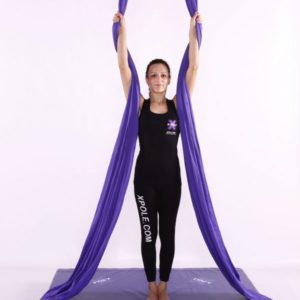
Best for: Students who already train with an instructor and have a professionally rigged point or a freestanding aerial frame
X Pole Aerial Silks
Medium-stretch, machine-washable fabric for practicing skills you've already learned in class. It's fabric only, so budget for rated rigging hardware as well.
- Machine washable
- Choice of lengths
- Suitable for home or studio use
- Rigging hardware sold separately
- Not a way to learn silks without an instructor
A crash mat and a trained instructor
Beginners should always train over a crash mat, with an instructor who’s trained to teach aerial and can spot you. A good instructor checks your wraps before you let go, which is exactly what you can’t yet judge for yourself. Learn inverts and anything involving height in class, not from a video.
The fabric is the easy part to trust. Ask about what it hangs from.
How long does it take to get good at aerial silks?
It depends on how often you train and where your strength starts. Speaking generally, the first few weeks are about getting comfortable in a foot lock and climbing a little higher each class. After a few months of regular training, many students can climb with confidence, invert in the air under supervision and link a couple of wraps into a short sequence. Drops (the dramatic unrolling moves) are intermediate skills and come later than that.
Once a week will get you there and twice a week gets you there faster, as long as your hands and shoulders get rest days in between. Progress tends to come in bursts: a climb that felt impossible for a month suddenly works because your grip finally caught up.

How aerial silks and pole dancing help each other
If you already pole, you’ve got a head start. Grip strength, shoulder strength and comfort being upside down all transfer, and so does the habit of pointing your toes. Silks pay you back. Climbing builds pulling strength and grip endurance that make pole climbs and holds feel easier, and fabric teaches you to find core tension when there’s nothing rigid to brace against.
The big adjustment is clothing: silks don’t rely on bare-skin grip, so you’ll be covered up instead of in shorts, and it’s worth asking before you bring pole grip aids to a silks class. We’ve written more about training both in pole and aerial as a workout combination. If you own a compatible X Pole that’s permanently fixed to the ceiling, our X Pole SILKII review covers an attachment that hangs silks from the pole itself.
Frequently asked questions
Can a complete beginner do aerial silks?
Yes. Beginner classes are designed for people who have never touched the fabric. You’ll start low, with plenty of ground-based conditioning, and build height as your strength and technique improve.
Do I need to be able to do a pull-up?
No. A pull-up will help eventually, but beginner classes don’t assume you have one. Dead hangs and scapular pulls are a better place to start.
Is aerial silks a good workout?
It’s a demanding full-body workout, especially for your grip, shoulders, back and core. Climbing and holding positions is strength work, and longer sequences will get your heart rate up as well.
Can I learn aerial silks at home?
Learn the basics in a studio with an instructor first. Home practice only makes sense once you know the skills, and only on a professionally rigged point or a purpose-built freestanding frame, with a crash mat underneath.
Is aerial silks the same as aerial yoga?
No. Aerial yoga uses a hammock, a single loop of fabric usually hung low, and focuses on supported stretches and gentle inversions. Silks are two separate tails hung much higher, and the skills are about climbing, wrapping and holding your own weight. Our comparison of aerial silks vs lyra vs the aerial hammock explains how the three differ.
Your first week on silks
Book a beginner class at a studio with trained instructors and proper rigging. It’s completely fine to ask how their points are rigged and who installed them; a good studio will be happy to tell you. Wear your leggings, skip the lotion and expect to spend most of the hour close to the mat.
Afterward, give your forearms a couple of days off, do a few dead hangs once the soreness fades, and go back. The second class is usually where silks start to feel less like a fight with a curtain and more like fun.
Sources
- Wikipedia, “Aerial silk” (other names, fabric types and stretch levels). en.wikipedia.org/wiki/Aerial_silk ↩︎
- Greenspan S, Stuckey MI. “Untangling risk factors including discipline-specific exposure for injuries in preprofessional and professional circus artists in the USA.” BMJ Open Sport & Exercise Medicine, 2023;9(2):e001551. Read the study ↩︎
- American Council on Exercise, “Don’t Be a Sore Loser: Dealing with Muscle Soreness” (ACE Fit Facts), 2013. ACE Fit Facts PDF ↩︎
- Firetoys, “Safe Home Rigging” (rigging guide for aerialists). firetoys.com ↩︎
- X-POLE US, “Aerial Silks” product page (rigging requirements: one rescue 8, two carabiners and one swivel, sold separately). xpoleus.com ↩︎
Want more articles like this?
Join our mailing list to be the first to know about the latest pole dancing news and products.
We only include the best content in our newsletter, which includes marketing material. Privacy Policy
NO SPAM – EVER. YOU CAN UNSUBSCRIBE AT ANY TIME.