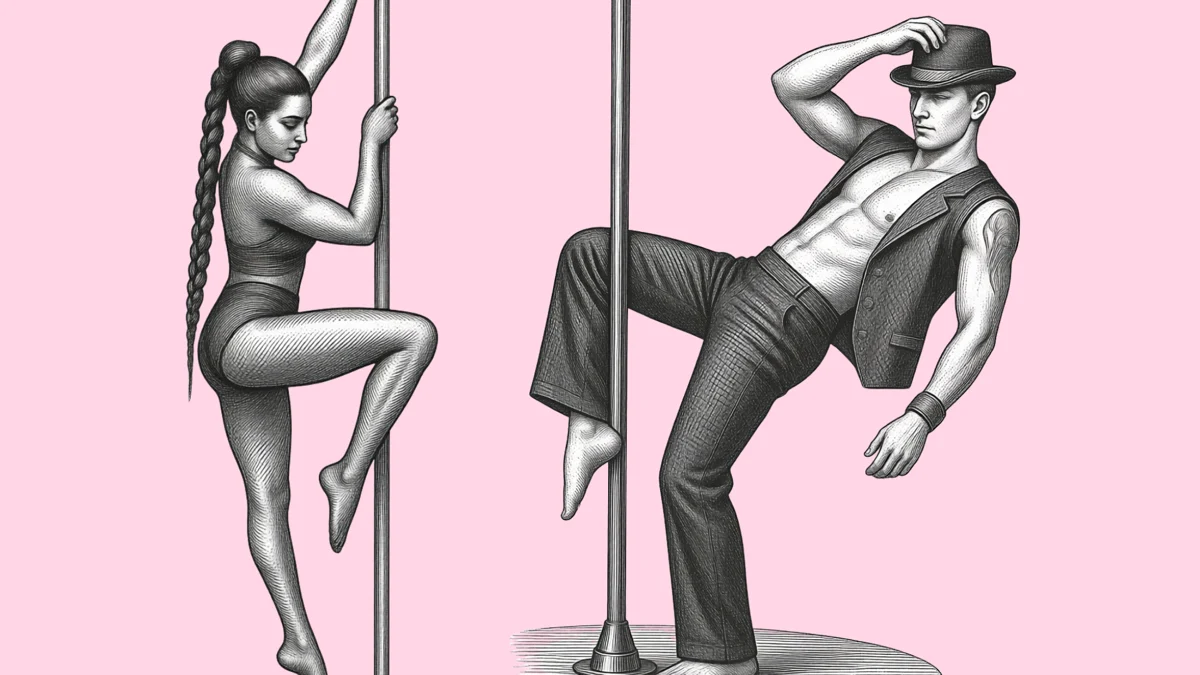

Walk into most pole studios on a Tuesday night and you’ll probably find a room full of women. That’s no accident. For years, pole classes were sold as a women-only escape. Now more men, trans and non-binary dancers want a pole too, and studios have to decide who their classes are for. So, should pole classes be women-only? Here’s what the people on each side say, what the law says, and how studios are handling it.
In this article:
- How pole classes ended up so female in the first place
- Why some dancers really value women-only classes
- The case for mixed classes, from male, trans and non-binary dancers
- What the law says in the US and the UK, including the 2025 Supreme Court ruling
- How studios are mixing women-only, open and LGBTQ+ classes on one timetable
Why this question keeps coming up
When I started teaching pole in 2011, every one of my classes was women-only for the first 18 months. Then men started signing up, and I also had students whose religion meant they couldn’t work out in a mixed room at all. We couldn’t keep everyone happy with one class, so we rebuilt the timetable around the people who actually wanted to come. I wrote a bit more about that in my tips for male pole dancers.
Since then I’ve taught in three different countries, and studios everywhere have come to very different answers. Some keep their doors firmly women-only. Some are open to everyone. A lot of them land somewhere in between. The arguments online tend to generate more heat than light, so I’ll try to give both sides a fair hearing here.
How pole became a “women’s thing”
Pole dancing as most of us know it grew up in strip clubs, and before that in traveling fairs. Writing in The Spinoff, Gabi Lardies traces it back to “hoochie coochie” dancers at early-1900s American fairs, who used the tent pole as a prop. She also notes that the jump from club to fitness studio is said to have started in 1994, when a Canadian stripper opened a dance school for the “everyday woman.”1
There’s another family tree too. Mallakhamb, the Indian pole discipline whose name means “wrestler’s pole,” has a long and hard-to-trace history of its own.2 People sometimes bring it up to prove that pole was “always” a man’s sport. That’s a bit of a stretch. Mallakhamb and Chinese pole are their own arts, and the spins, floorwork and heels that studios teach today came from dancers in clubs. If you want the full story, there’s more in our history of pole dancing and our piece on the #NotAStripper vs. #YesAStripper row.

When pole moved into studios, it was sold almost entirely to women. Researchers who looked at 15 Australian studio websites found them leaning on pole’s erotic image and selling it to women as a way to feel empowered through their sexuality.3 Sociologist Samantha Holland, who gathered 135 questionnaires and 37 interviews from pole dancers for her 2010 book, found that the women she met valued the friendships they made in class, the extra confidence and the pleasure of feeling their bodies move freely. She was also careful to point out that this kind of empowerment tends to be personal, rather than something that changes the world outside the studio.4
So the “women’s space” feeling didn’t come out of nowhere. For a lot of students, it’s the whole reason they walked through the door.
The case for women-only pole classes
You’re wearing very little, and you’re upside down
This is the one that comes up most, and it’s a fair point. You need bare skin to grip the pole, so most of us train in shorts and a sports bra (see what to wear to pole class). Then you spend an hour going upside down with your legs open, often in front of a wall of mirrors. Plenty of women who’d happily lift weights next to men draw the line at that.
Body image comes into it too. Pole is one of the few workouts where a lot of women learn to actually like how their bodies look and move. For some, that only feels possible when there are no men in the room. If that’s you, our piece on pole dancing and body confidence is worth a read.
Safety, harassment and trauma
Women don’t ask for women-only spaces on a whim. In a 2021 survey of gym members by the fitness review site RunRepeat, 56% of the 1,107 women said they’d been harassed at the gym, compared with 21% of men. About a quarter of the women who’d been harassed said they’d stopped going to the gym or switched gyms because of it. It’s a commercial survey and doesn’t say much about how people were recruited, so treat the exact numbers with some caution, but it matches what plenty of women describe.5
Some of the women who find their way to pole are survivors of sexual violence. Pole can be a powerful way to feel at home in your body again, but a man in the room can make that much harder for some survivors. Trauma-informed approaches, as set out by the CDC and SAMHSA’s National Center for Trauma-Informed Care, put safety, choice and a person’s own voice first, and they ask practitioners to take gender, culture and history into account.6 For some students, that means a women-only class. For others, it just means a teacher who asks before touching and never forces a move.
Faith and culture
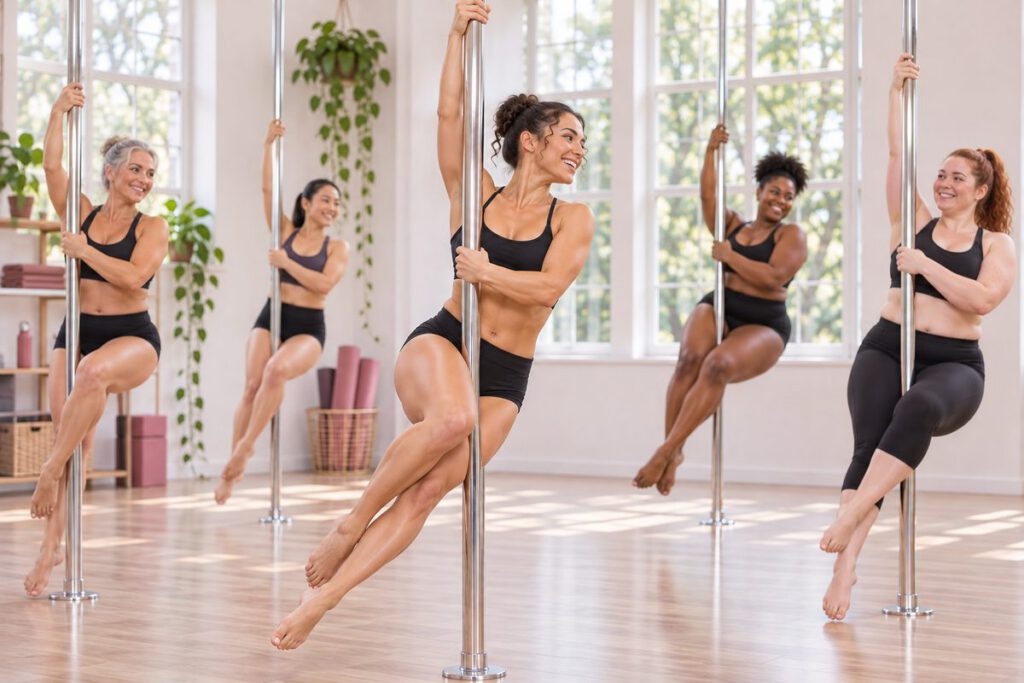
This one gets forgotten in online arguments, but I’ve had students in exactly this position. Some women can’t exercise in a mixed room for religious or cultural reasons. If a studio only runs mixed classes, those women don’t get to pole at all. A women-only class is often the only door that’s open to them.
Sensual styles feel different
A pole sport conditioning class and a slow, sensual heels class are very different experiences. Lots of students are fine training tricks next to anyone, but want a more private room for exotic pole, floorwork and body rolls. Back in 2010, Salon visited a Philadelphia studio that ran its women-only classes with a “self-expression” section, alongside a separate coed class that was more like a boot camp. The coed class existed because some men wanted to learn pole but weren’t comfortable with the dance-heavy regular sessions.7
That’s an interesting detail. The discomfort isn’t only on the women’s side.
The case for mixed and inclusive classes
Men pole too, and there are more of them every year
Male pole dancers aren’t new, but there are a lot more of them now. When the International Pole Sports Federation held its first World Championships in 2012, only five of the 43 competitors were men. In 2017, IPSF opened male junior and novice categories for the first time, and it says that pushed male participation up by more than 70%.8 The other big federation, POSA, now runs Seniors Men Mix, Masters Men and mixed doubles categories at its world championships.9 You can find more events in our list of pole dance competitions.

Every one of those men had to learn somewhere. If most studios in a town are women-only, a beginner who happens to be a man often has nowhere to start, or ends up paying for private lessons that cost far more than a group class. And when men do find a class, the stigma can be tough. A 2020 study of male exotic pole dancers in South Korea points out that it’s still unusual there for men to take part in activities seen as female, and explores how these dancers define their own gender identity while they dance.10
The room changes what people learn
Researchers in Copenhagen spent time in pole classes and found that both the style of class (sporty or sexy) and whether it was women-only or mixed shaped what helped or held back men and women in how they expressed gender. They also noticed that the ideal pole body mixes qualities we’d usually label feminine and masculine. Think strength and flexibility in the same move.11 I love that about pole. It doesn’t really care who you are, as long as you turn up and train.
“Women-only” can shut out trans and non-binary dancers
This is where things get more complicated, and it’s worth listening to the people affected. In a 2020 post for the International Pole Convention, a non-binary trans writer argued that women-only classes and workshops can leave non-binary and agender dancers feeling they have to misgender themselves to get in, or stay away altogether. Their suggestions for studios were simple: let students share their pronouns, have trans and queer instructors, and stop gendering classes.12
Many pole spaces have tried to answer this by widening the definition. Miss Pole Dance Australia, for example, says its performers “must be female or female identifying,” and that people outside the gender binary are welcome to apply.13 Some studios do the same with “women and femmes” or “women and non-binary” classes. Others have dropped gendered labels altogether.
Safety comes from rules, not from who’s in the room
People who run mixed classes often say that a women-only label is a blunt tool. It keeps out the men who would never cause a problem, and does nothing about bad behavior from anyone else. What actually keeps a class safe is a teacher who sets clear rules about touching, photos and comments, and who acts when someone breaks them. If a studio can’t manage that, a sign on the door won’t fix it. (I’ve written about the red flags to look for in a pole studio, and most of them have nothing to do with gender.)
What the law says
Most of our readers are in the US, but a lot of the recent news has come out of the UK, so I’ll cover both. This is a general overview, not legal advice. If you run a studio and want to change your policy, please speak to a lawyer where you are.
In the US, it depends on your state
The main federal law on public accommodations, Title II of the Civil Rights Act of 1964, covers race, color, religion and national origin. It doesn’t cover sex.14 That leaves it mostly to the states, and they don’t agree.
- California: the Unruh Civil Rights Act bans business discrimination based on sex, and defines gender to include gender identity and gender expression.15
- Massachusetts: the law makes a specific exception for single-sex “bona fide fitness” facilities that don’t take government money. It also says that where a place lawfully separates people by sex, it has to admit people in line with their gender identity.16
- Illinois: the Human Rights Act lets the state grant sex-based exemptions for “distinctly private” facilities, and it names health clubs.17
- Connecticut: in 2022, the state’s Supreme Court ruled that its public accommodation law has no implied “customer gender privacy” exception, in a case about women-only workout areas at two gym chains.18
So a women-only pole studio could be fine in one state and risky in the next, and the rules for running a few women-only sessions alongside open classes vary too. Local advice really matters here.
In the UK: the Equality Act and the 2025 Supreme Court ruling
In England, Scotland and Wales, the Equality Act 2010 lets businesses run separate or single-sex services in certain situations, as long as doing so is “a proportionate means of achieving a legitimate aim.” The conditions include where a mixed version is also offered but wouldn’t work well enough on its own, where several people use the service at once and someone might reasonably object to the opposite sex being there, and where physical contact is likely. The Act also has a separate rule allowing providers to treat trans people differently in connection with those services, but again only where it’s proportionate.19
On April 16, 2025, the UK Supreme Court ruled unanimously in For Women Scotland v The Scottish Ministers that “man,” “woman” and “sex” in the Equality Act refer to biological sex. That means a trans woman with a gender recognition certificate isn’t counted as a woman for the purposes of the Act. The court also said this “does not remove protection from trans people,” who are still protected from discrimination and harassment because of gender reassignment.20 Reading out the ruling, Lord Hodge asked people not to see it “as a triumph of one or more groups in our society at the expense of another.”21
Britain’s equality regulator, the EHRC, then updated its statutory guidance for service providers, which came into force on August 5, 2026. It doesn’t create new law, but courts have to take it into account. For pole studios, a few parts stand out:
- One of its examples is a gym that adds a women-only class once a fortnight after some members ask for one, while keeping its mixed classes. The guidance says that’s “likely to be lawful.”
- It says a service open to women and trans women isn’t a single-sex service under the Act, and is “very likely to amount to unlawful sex discrimination” against people of the opposite sex who are left out.
- It also says trans people are likely to be disadvantaged by single-sex services, that providers have to weigh that up, and that a mixed service open to everyone can run alongside a single-sex one.22
All of this is still being argued over. Many trans people and LGBTQ+ organizations have criticized the ruling and the guidance, and campaigners are challenging the EHRC in court. In February 2026 the High Court rejected a challenge to the regulator’s earlier interim advice. In October, the Court of Appeal agreed to hear the claimants’ bid to appeal.23 Separate legal letters have also been sent challenging the new guidance itself.24 UK studio owners should expect the advice to keep shifting for a while yet.
It’s also a business decision
Principles aside, most studio owners are small business owners who need to fill classes and pay rent. A women-only brand can be a big selling point. Plenty of women book a first class precisely because they know it’s women-only, and a studio that suddenly opens up might lose some of them.
On the other hand, closing your doors to men, trans and non-binary dancers means turning away paying students and future instructors, and some potential students will see a women-only policy as old-fashioned. In 2017, the Denver magazine OUT FRONT profiled Tease Studio, where owner Ashlee Renee cut her women-only classes down to two, opened the rest to all genders and started hiring male instructors. Her reasoning: “being sexy, confident, and healthy is genderless.”25
If you’re thinking of opening your own space, I’d decide this early and be upfront about it on your website. It’s part of working out who your studio is for, which I cover in how to start a pole dancing business.
The middle ground most studios end up in
Plenty of studios don’t pick a side at all. Instead, they build a timetable with a bit of everything:
- Women-only sessions at set times, for students who need them for comfort, trauma or faith reasons.
- Open classes that anyone can book, especially pole sport, tricks and conditioning.
- Men’s or beginner men’s classes where there’s demand, so new male students aren’t thrown in at the deep end.
- LGBTQ+ or queer classes, which give trans, non-binary and queer dancers a space of their own.
- Private lessons for anyone who doesn’t feel ready for a group yet.
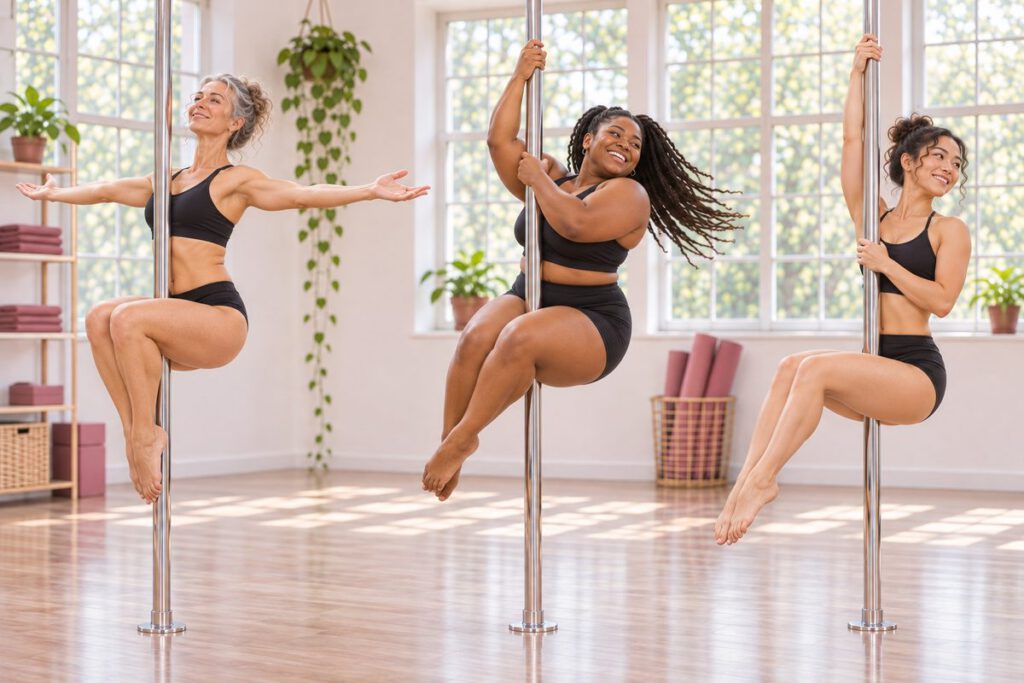
LGBTQ+ classes deserve a special mention, because they’re growing. Washington State University has run a free, walk-in Queer Pole Fit class since 2024, and the coordinator who set it up told the student paper that “you’re allowed to present however you are.”26 Other studios go further. Selenite Studio near Denver makes every class open to all genders and asks for pronouns at the start of each one. Its owner, Nico Paradis, describes students as being “at various stages of their healing journey,” which shows that trauma-informed teaching and all-gender classes can go hand in hand.27
Questions to ask before you book
Is this class women-only, mixed or open to all genders, and what does the studio mean by that? Is there a code of conduct, and who do I talk to if something goes wrong? Will the instructor ask before spotting or touching me? Can I take a women-only, men’s or LGBTQ+ class if I’d feel more comfortable? A good studio will be happy to answer all of these before your first class.
So, should pole classes be women-only?
My honest answer is that some of them should, and most of them shouldn’t have to be. Women-only classes meet real needs: privacy, safety, recovering from trauma, faith. Nobody should be made to feel guilty for wanting one, or for running one where the law allows it.
But pole doesn’t belong to any one group. It came from strippers, it’s practiced by athletes, and these days you’ll find it danced by people of every gender. When the only classes in town are women-only, the people left out are often the ones who already have the hardest time finding somewhere to train: men who face stigma just for trying it, and trans and non-binary dancers who don’t fit neatly into either box.
For me, the best studios offer a mix of rooms, are clear about who each class is for, and enforce the same standards of respect in all of them. Where you can train should depend on what you need, not on who you are.
What do you think? Should your studio be women-only, open to everyone, or a bit of both? Tell me in the comments. And if you’re still deciding whether to give pole a go, start with our guide to pole dancing for beginners.
Sources
- Gabi Lardies, “‘It’s ignorance and it’s privilege’: What do strippers make of the pole fitness boom?”, The Spinoff, April 28, 2025. ↩︎
- Patrick McCartney, “Poles apart? From Wrestling and Mallkhāmb to Pole Yoga”, Journal of Yoga Studies, vol. 4, 2023, pp. 215–270. ↩︎
- Ngaire Donaghue, Tim Kurz and Kally Whitehead, “Spinning the pole: A discursive analysis of the websites of recreational pole dancing studios”, Feminism & Psychology, vol. 21, no. 4, 2011, pp. 443–457. ↩︎
- Samantha Holland, Pole Dancing, Empowerment and Embodiment, Palgrave Macmillan, 2010. Research methods and findings as summarized in Elke Weissmann’s review, Participations, vol. 8, no. 2, November 2011. ↩︎
- Nicholas Rizzo, “Gym Harassment”, RunRepeat, June 29, 2021, updated November 2, 2023. ↩︎
- Centers for Disease Control and Prevention and SAMHSA’s National Center for Trauma-Informed Care, “6 Guiding Principles to a Trauma-Informed Approach”, infographic, June 2, 2022. ↩︎
- Margaret Eby, “Inside a male pole-dancing class”, Salon, May 21, 2010. ↩︎
- International Pole Sports Federation, “History of Pole Sports”. ↩︎
- Pole Sports & Arts World Federation (POSA), Rules & Regulations, Version 2026. ↩︎
- Yunjung Kim and Sun Yong Kwon, “‘Before I am biologically a male, I am me’: Exploring gender identity of South Korean male exotic polers”, International Review for the Sociology of Sport, vol. 56, no. 7, 2021 (online 2020), pp. 1035–1050. ↩︎
- Andorra L. Jensen and Lone F. Thing, “Performing Gender in Recreational Pole Dancing: Enabling and Constraining Factors”, Sociological Focus, vol. 55, no. 3, 2022, pp. 254–270. ↩︎
- Natalia S., “5 Tips for Studios to Be More Trans Inclusive”, International Pole Convention, June 19, 2020. ↩︎
- Miss Pole Dance Australia, “Rules and Regulations”. ↩︎
- 42 U.S.C. § 2000a, “Prohibition against discrimination or segregation in places of public accommodation”, Legal Information Institute, Cornell Law School. ↩︎
- California Civil Code § 51 (Unruh Civil Rights Act), California Legislative Information. ↩︎
- Massachusetts General Laws, chapter 272, § 92A, via FindLaw. ↩︎
- 775 ILCS 5/5-103(B), Illinois Human Rights Act, via FindLaw. ↩︎
- Commission on Human Rights and Opportunities v. Edge Fitness, LLC, 342 Conn. 25 (2022), Connecticut Judicial Branch Law Libraries, January 25, 2022. ↩︎
- Equality Act 2010, Schedule 3, Part 7 (paragraphs 26–28): Separate and single services, legislation.gov.uk. ↩︎
- UK Supreme Court, For Women Scotland Ltd v The Scottish Ministers [2025] UKSC 16, press summary, April 16, 2025. ↩︎
- Polly Botsford, “Supreme Court rules ‘woman’ has biological meaning”, Legal Cheek, April 16, 2025. ↩︎
- Equality and Human Rights Commission, Code of Practice for services, public functions and associations, Chapter 13: Exceptions, in force August 5, 2026. ↩︎
- Good Law Project, “EHRC guidance: We’re heading to the Court of Appeal”, October 16, 2026. ↩︎
- “Equalities watchdog faces judicial review challenge over updated Code of Practice”, Local Government Lawyer, August 6, 2026. ↩︎
- “Choreo Queens: The Women of Tease Studio Shake the Stigma of Pole Dancing”, OUT FRONT, September 6, 2017. ↩︎
- Laney Kulman, “Queer Pole Fitness provides inviting atmosphere and beginner friendly classes”, The Daily Evergreen, January 8, 2025. ↩︎
- Justin Goodrum, “Selenite Studio Transforms Pole Dancing Into a Space for Healing and Self-Love”, OUT FRONT, October 13, 2025. ↩︎
Want more articles like this?
Join our mailing list to be the first to know about the latest pole dancing news and products.
We only include the best content in our newsletter, which includes marketing material. Privacy Policy
NO SPAM – EVER. YOU CAN UNSUBSCRIBE AT ANY TIME.
Leave a Reply